The condition of a building’s external envelope will be one of the best predictors of its long-term performance, resilience and financial viability.
Yet across so many commercial estates, education environments, historic buildings and mixed-use developments, façade and roof maintenance continues to be treated reactively, and addressed only when visible symptoms come to light.
A specialist building condition survey is the best way to challenge this mindset as it shifts attention from emergency repair to evidence-based asset planning and gives owners a mechanism to protect the value, safety and function of their buildings for decades rather than years.
In this blog we’ll look at the importance of specialist building condition surveys, and how we at Building Transformation are approaching things differently.
A Condition Survey Is Not a Visual Check; It Is a Diagnostic Audit
Many owners and even some contractors still assume that a condition survey is simply a quick visual inspection of the façade or roof.
But an accurate façade condition survey is a structured technical audit conducted by specialists who understand not only what they are looking at but also why specific defects emerge and how they propagate across the wider system. It draws on diagnostic tools, moisture testing, detailed photographic evidence, defect mapping and close quarter inspection techniques to evaluate the real performance of the building envelope.
The façade is an integrated defensive system. For it to work effectively, interfaces, fixings, membranes, sealants, drainage paths and insulation layers must all behave as intended. Failures rarely originate from dramatic events.
They begin with subtle, early indicators that only trained specialists can detect. A structured audit identifies these signals long before water ingress, thermal inefficiencies or material failures become visible.

Compliance, Standards and the Protection of Warranties
A façade or roof that hasn’t been checked against recognised performance standards quickly becomes an unknown quantity. You may notice things like energy efficiency starting to slip, or moisture moving in ways designers never intended, and the problem with warranties is that they can then quietly lose their validity. Standards such as BS 6229 exist for a reason: they provide a common benchmark for what “good” roof performance looks like. Likewise, Part L of the Building Regulations depends on the building continuing to behave as designed, which means its envelope needs ongoing, informed oversight – not occasional glances when something goes wrong.
This is where a proper condition survey becomes more than a technical exercise.
It gives owners and surveyors the evidence they need to show that the building is being actively cared for.
When a manufacturer or insurer asks for proof of maintenance, a thorough, professionally documented survey becomes the reassurance they rely on. Without it, warranty terms can weaken, disputes become harder to resolve, and owners can find themselves responsible for issues that should have been covered. A well-structured audit protects the building, but equally importantly, it protects the budget, the warranty, and the people accountable for keeping the asset performing as it should.
Specialist Access Expertise: Seeing What Others Cannot Reach
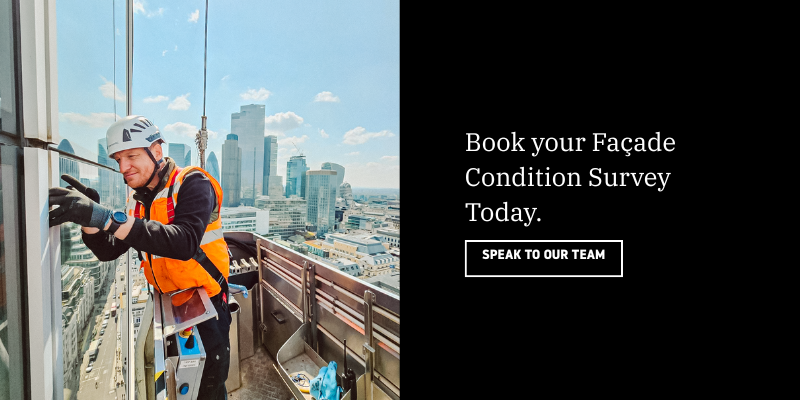
One of the biggest advantages of a professional façade condition survey is the simple fact that it lets experts get to places most people can’t. Many issues and major defects can start in hidden corners of the building envelope, along roof edges, behind cladding joints, around penetrations or on high-level façades where nobody ever gets close enough to see what is really happening.
Surveyors regularly rely on Building Transformation’s rope access teams, MEWPs, cradles and more advanced access methods to physically reach these areas and examine them up close. Without this level of access, they’re forced to make assumptions based on distant visuals or incomplete information.
By working side by side with our specialist access technicians, surveyors can confirm what is actually happening rather than what might be happening. It removes guesswork entirely. Instead of presenting clients with tentative observations or reserve-heavy recommendations, they can provide confident, evidence-backed advice. It also saves unnecessary disruption, because it avoids the need to erect scaffolding just to reach a single area of concern. In day-to-day practice, this collaboration leads to richer insight, better long-term forecasting and far more reliable maintenance decisions.
Defect Mapping and Data-Led Maintenance Planning
Another reason specialist surveys are so valuable is that the information gathered doesn’t just sit in a report; it becomes structured, mappable intelligence that owners can act upon. During a façade condition survey, every defect is logged and digitally pinned to the building’s plans.
Even the smallest details, such as early blistering in a membrane, an area of sealant beginning to break down or slight panel movement, are recorded with precision and supported by clear photographic evidence. When this level of detail is paired with a RAG-style prioritisation system, the result is a maintenance blueprint that makes sense at both strategic and day-to-day levels.
This process removes the ambiguity around the defect identification phase. Instead of vague descriptions or broad recommendations, building managers and asset owners get a clear picture of what is happening, why it matters and how urgently it needs attention. They can see which issues pose immediate risk, which ones need watching, and which can be incorporated into future planned works.
Decisions stop being driven by unexpected failures and start being shaped by real data. Budgets become more predictable, planned maintenance becomes easier to justify, and the overall lifespan of the asset is extended because intervention happens at the right time, not the last possible moment.

Spotting Early Warning Signs Before They Escalate
A façade or roof envelope almost never fail out of the blue.
Long before a leak shows up inside a building or a piece of cladding starts to shift, the structure will give off subtle warning signs that something isn’t quite right.
These early clues might be as small as slight material fatigue, a faint ripple or undulation in a panel, hairline cracks, hollow-sounding render, or a bit of distortion around penetrations. Sometimes it’s the first hint of moisture tracking where water has begun to move in ways the original detailing didn’t anticipate. From ground level, or during routine maintenance, these signs are incredibly easy to miss.
Specialist surveyors who understand how façades behave over time are trained to spot these details and interpret what they mean for the wider system. They know which issues are simply cosmetic and which ones signal deeper problems developing beneath the surface. This ability to read the building’s early warning signs is what allows owners to act before a minor defect becomes a serious failure. By catching issues early, interventions are simpler, more cost-effective and far less disruptive. More importantly, early action protects the building’s reputation and performance, ensuring problems never escalate into the kind of failures that draw attention for the wrong reasons.
From Insight to Action: How Building Condition Surveys Enable Accountability and Planning
A major advantage of a structured condition survey is the generation of a clear, defensible maintenance record. This becomes invaluable when dealing with manufacturers, insurers, leaseholders, and internal stakeholders who require reassurance that the building has been appropriately managed. The survey provides documented evidence of due diligence, confirming that inspections have been conducted by qualified specialists using approved methods.
This record strengthens warranty claims, protects against disputes, and demonstrates that the building owner has taken reasonable steps to preserve the asset. It also feeds directly into maintenance and capital planning. With a clear understanding of condition, risk exposure, and the scale of future work, owners can determine realistic budgets and establish maintenance cycles that extend the lifespan of the building envelope.

The Building Transformation Approach
Building Transformation’s value comes from the way specialist knowledge, safe access methods and rigorous diagnostics come together in a single, integrated service. Our teams don’t just support surveyors by reaching high or awkward areas – they work alongside them to identify issues that can’t be seen without getting close to the façade itself. Because we’ve spent years working on everything from heritage structures to high rise façades, composite cladding systems, ageing roofs and complex hybrid installations, we’ve learned to recognise the subtle patterns of deterioration that can compromise performance long before they become visible.
What sets our approach apart is the emphasis on accuracy, safety and genuinely useful insight. We treat the building as a living system rather than a series of detached elements, which means every survey is designed to understand how materials, interfaces and details interact over time. The diagnostics we produce give surveyors complete, first-hand evidence that they can trust when advising clients on both immediate actions and long-term plans. The result is a clearer picture of the building’s true condition and a stronger foundation for confident, technically sound decision-making.
As buildings age, environmental pressures intensify and regulatory expectations tighten, proactive condition assessment becomes increasingly essential. A specialist façade condition survey is therefore not only good practice, it is a crucial safeguard for anyone committed to maintaining the safety, performance and financial resilience of their estate.