The challenge
A specialist rope access risk assessment can identify critical safety concerns before complex work-at-height operations begin. Building Transformation was appointed to provide independent technical scrutiny of a cleaning contractor’s proposed rope access strategy for a large, sloping glazed atrium at a commercial building in London.
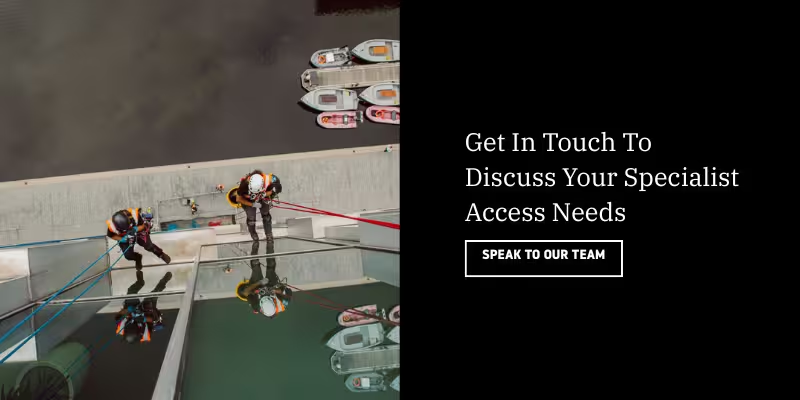
The planned cleaning works presented significant access and safety challenges. Rope Access Technicians would be required to operate on a sloping glazed roof using tensioned rope systems, temporary rigging arrangements and specialist access equipment.
With occupied areas beneath the glazing, protecting both operatives and building users was a critical consideration.
Our role was to independently assess the proposed methodology, reviewing whether the access arrangements were technically justified, appropriately planned and supported by sufficient safety evidence.
Learn more about our Rope Access Planning Services
Our approach: Independent rope access risk assessment and technical review
Led by Gavin Whitlock, Building Transformation’s Specialist Access Manager, our team undertook a detailed technical review of the contractor’s risk assessments and method statements (RAMS), proposed rigging configurations, equipment specifications and emergency rescue procedures.
The assessment went beyond a conventional documentation review. Drawing on extensive practical rope access experience, Gavin examined how the proposed systems would perform in real working conditions, considering structural loading, rope configurations, operative movements, rescue scenarios and the potential impact on building occupants.
The review identified several significant safety concerns requiring further technical evidence, clarification and corrective action.
- Unverified anchor capacities and complex rigging arrangements
The proposed tensioned rope system introduced potentially substantial forces at anchor points. Temporary tripods were also proposed as rope deviations, raising concerns about lateral loading, stability and the potential for overturning.
Gavin identified the need for structural verification, engineered loading calculations and evidence confirming that the proposed anchors and equipment were suitable for the intended application.
This highlighted the importance of a thorough understanding of rope access safety and work-at-height planning when developing complex rigging arrangements.
Without this supporting information, the adequacy of the rigging arrangements could not be established.
- Potential gaps in continuous fall protection
The proposed access sequence appeared to allow a technician to transition onto the atrium edge before both independent rope systems were connected.
This raised concerns about maintaining appropriate fall protection during a particularly vulnerable stage of the operation.
The technical review recommended clarification and revision of the method statement to demonstrate continuous two-rope protection throughout access, work positioning and exit.
- Rescue planning for a complex sloping roof
Effective rope access safety depends on having a practical, site-specific rescue strategy that accounts for the actual working environment.
The submitted rescue procedure described a conventional vertical rope rescue but did not adequately address how an incapacitated technician could be recovered from the sloping glazed roof and tensioned rope system.
Gavin recommended a more detailed rescue strategy addressing casualty recovery, equipment requirements, rescue team competence, staffing and the suitability of any supporting mobile elevating work platform (MEWP).
The review highlighted the importance of ensuring that emergency arrangements are not only documented but technically achievable within the proposed access configuration.
- Structural integrity and protection of building occupants
The review also identified insufficient evidence confirming the glazing’s load-bearing capacity and inadequately defined exclusion zones beneath the proposed working area.
These issues were particularly significant because dropped objects, equipment failure or damaged glazing could potentially affect occupied areas below.
The assessment recommended confirmation of permissible structural loads, alongside clearly defined exclusion zones and access controls to protect building users during the proposed operation.
The outcome: Six critical safety hold points identified
Building Transformation delivered a comprehensive technical review and corrective action schedule, identifying significant omissions and inconsistencies in the proposed rope access methodology.
The independent assessment established six critical safety hold points relating to:
- Structural loading: Verification of glazing capacity and supporting structural evidence.
- Rigging integrity: Assessment of anchor capacities, tensioned rope forces and temporary rigging arrangements.
- Fall protection: Demonstration of continuous two-rope protection throughout the operation.
- Rescue planning: Development of a practical, site-specific emergency recovery strategy.
- Exclusion zones: Adequate protection of building occupants and areas beneath the workface.
- Risk assessment: Identification and evaluation of task-specific hazards and appropriate control measures.
Each finding was accompanied by clear technical recommendations and requirements for supporting evidence.
The result was an independent, evidence-led assessment that enabled the client to understand the risks, challenge the proposed methodology and make informed decisions about the next steps.
Why specialist rope access consultancy matters
Complex rope access operations require more than qualified technicians and standard risk assessments and method statements.
They demand a detailed understanding of structural forces, equipment limitations, rigging configurations, work positioning, emergency rescue and the wider building environment.
Engaging experienced specialists during the planning stage can help property managers, surveyors and principal contractors identify gaps in proposed access strategies before operatives are exposed to potentially serious risks.
Through our rope access planning and consultancy services, Building Transformation provides the technical expertise needed to assess complex access arrangements, challenge proposed methodologies and support informed decision-making.
This project demonstrates how Building Transformation’s practical rope access experience supports clients beyond the physical delivery of works.
Through independent technical reviews, specialist access consultancy and work-at-height risk assessment support, we help clients evaluate challenging access proposals and make informed decisions about safe delivery.
Recognising our team’s expertise
Gavin’s depth of knowledge, attention to detail and practical understanding of complex rope access systems were instrumental in identifying the issues and developing clear, constructive recommendations.
This is an excellent example of the specialist expertise within Building Transformation and the value it brings to our clients.
Need specialist rope access planning advice?
Planning a complex work-at-height operation or reviewing a contractor’s proposed access methodology?
Building Transformation provides specialist access consultancy, technical RAMS reviews and practical advice on complex rope access, rigging and rescue arrangements.
Our team combines hands-on experience with technical knowledge to help clients understand access challenges, assess proposed methods and identify appropriate safety considerations.