Working at height is a routine requirement across commercial buildings, industrial facilities and infrastructure assets.
Roofs need inspecting. Façades need repairing. Gutters need clearing. Glazing, coatings and external building components often need to be reached in locations where conventional access is difficult.
The work itself may be straightforward. Reaching the area safely is not.
Falls from height remain one of the most serious risks within construction, facilities management and building maintenance. Provisional Health and Safety Executive figures for 2025/26 recorded 31 worker fatalities resulting from falls from height, making them the most common type of fatal workplace accident in Great Britain during that period.
For facilities managers, surveyors, property managers and building owners, this is not simply something for the contractor to manage once work begins.
Anyone involved in planning, procuring or controlling work at height needs enough understanding to assess whether the proposed access method is appropriate, whether the contractor is competent and whether foreseeable risks have been properly considered.
One important part of that assessment is understanding fall factor.

What Is Fall Factor?
Fall factor is a way of describing the potential severity of a fall within a rope or lanyard system.
In simple terms:
Fall factor = free-fall distance ÷ length of active rope or lanyard
The calculation compares how far somebody could fall before the system arrests them with the length of rope or lanyard available to manage the energy created by that fall.
This matters because two falls covering a similar distance can create very different demands on the person, anchor and fall-protection equipment.
A short connecting system subjected to a relatively long free fall will generally experience a more severe loading than an arrangement where free fall has been minimised.
However, fall factor should not be treated as a complete safety calculation.
The outcome of a fall can also depend on:
- The type and length of lanyard or rope
- The performance of the energy absorber
- The user’s weight, clothing, tools and equipment
- Anchor position
- Anchor-system movement or deflection
- Harness fit and adjustment
- Edge hazards
- Swing falls
- Available clearance
- Compatibility between system components
For facilities managers and surveyors, fall factor is therefore best treated as an indicator.
If a proposed system creates a high fall factor, it should prompt further questions about anchor position, free-fall distance, equipment selection, clearance and rescue.
What Are Fall Factors 0, 1 and 2?
Fall factor is commonly explained using three basic configurations.
The position of the anchor relative to the person using the system has a significant influence on the potential free-fall distance.
Fall Factor 0: Anchor Above the User
A Fall Factor 0 or near-zero arrangement is generally the preferred configuration within a fall-arrest system.
The anchor is positioned above the user and slack within the connecting system is kept to a minimum.
Strictly speaking, a true Fall Factor 0 means that there is effectively no free fall before the system becomes loaded. An overhead anchor does not automatically achieve this if the operative is using a long or excessively slack lanyard.
A correctly designed overhead arrangement can help provide:
- Minimal free fall
- Lower demand on the energy absorber
- Lower loading on the anchor system
- Reduced clearance requirements
- Less opportunity to strike the structure
- A more favourable position for rescue
Where fall arrest is required, keeping the connection as high as reasonably practicable is generally preferable.
However, fall arrest should not automatically be the first access solution considered.
Fall Factor 1: Anchor Around Body Level
A Fall Factor 1 arrangement can occur where the anchor is approximately level with the user’s dorsal attachment point between the shoulder blades.
If the operative moves away from the anchor using a two-metre connecting system, they could potentially fall approximately the length of that system before the fall begins to be arrested.
Compared with an overhead connection, this increases the free-fall distance and the clearance required beneath the operative.
That does not automatically mean the system is unsuitable.
It may be permissible with correctly selected equipment, but it should never be accepted without checking the manufacturer’s instructions, the actual working position and the full clearance calculation.
Fall Factor 2: Anchor Below the User
Fall Factor 2 represents the highest conventional fall-factor position.
It can occur when an operative works above their anchor point or connects at approximately foot level.
In a simple system, the potential free fall can approach twice the active length of the rope or lanyard.
This can result in:
- A significantly longer free fall
- More energy for the system to manage
- Greater demand on anchors and equipment
- Increased likelihood of contact with the structure
- Greater clearance requirements
- A more complicated rescue
Some equipment may be tested or approved for severe fall conditions. That does not make Fall Factor 2 a desirable routine working arrangement.
The objective should normally be to eliminate or minimise these situations during the planning stage.
The underlying principle is straightforward:
Keep the connection as high as practicable, minimise slack and free fall, and verify the complete clearance against the manufacturer’s information.
Fall Arrest Should Not Be the Starting Point
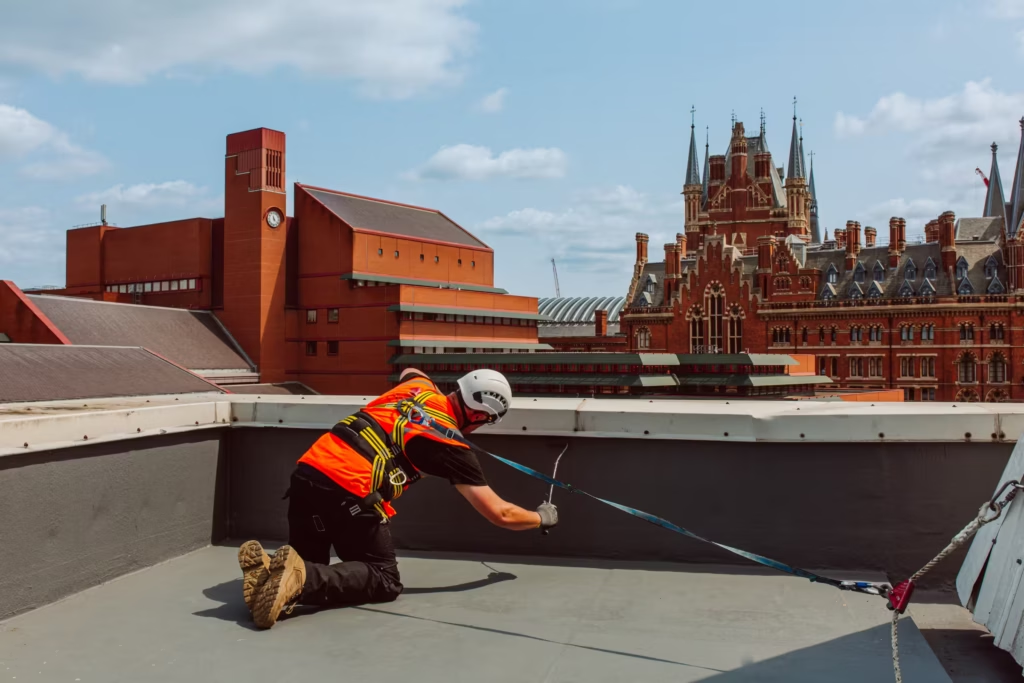
One of the common mistakes when procuring high-level work is starting with the assumption that an operative will wear a harness and attach themselves to an anchor.
The first question should be whether the risk can be avoided.
The Work at Height Regulations require duty holders to avoid work at height where reasonably practicable. If it cannot be avoided, measures should be considered that prevent a fall before relying on equipment designed to arrest one.
Depending on the building and the task, suitable access or protection could include:
- Completing the work from ground level
- Permanent edge protection
- Temporary guardrails
- Scaffolding
- Mobile access towers
- Mobile elevating work platforms
- Work-restraint systems
- Fall-arrest systems
- Specialist industrial rope access
There is no single access method that is correct for every project.
A MEWP may work well around one elevation but be impossible to position around another. Scaffolding may suit a long-duration refurbishment but be disproportionate for a short inspection. Rope access can provide efficient close access to many façades and structures, but it still requires suitable anchors, competent technicians, supervision and rescue arrangements.
Read our article: Rope Access vs Scaffolding vs MEWPs: A Practical Comparison
The access method should follow the requirements of the task and building.
It should not be selected simply because it produces the lowest quotation or the smallest site footprint.
What Is Fall Clearance?
Fall factor and fall clearance are closely connected, but they are not the same thing.
Fall factor describes the relationship between free-fall distance and the active length of the connecting system.
Fall clearance considers the total distance required beneath the operative for the system to stop a fall safely.
A fall-arrest system can operate exactly as designed and the operative can still strike a lower roof, balcony, scaffold, plant installation, vehicle or part of the building if there is insufficient space below them.
A clearance assessment may need to include:
- The operative’s starting position
- Lanyard and connector length
- Free-fall distance
- Energy-absorber deployment
- Anchor-system deflection
- Harness and body movement
- User height
- An appropriate safety margin
Clearance requirements are specific to the equipment and system being used.
They should therefore be established from the manufacturer’s information for the actual proposed configuration rather than copied from a generic diagram.
Anchor strength alone is also not enough.
An anchor can be structurally suitable but badly positioned. A low anchor can increase free-fall distance. An anchor too far to one side can create a pendulum or swing fall. A technically compliant system can therefore still be inappropriate for the way the work needs to be carried out.
What Questions Should FM Managers and Surveyors Ask Contractors?
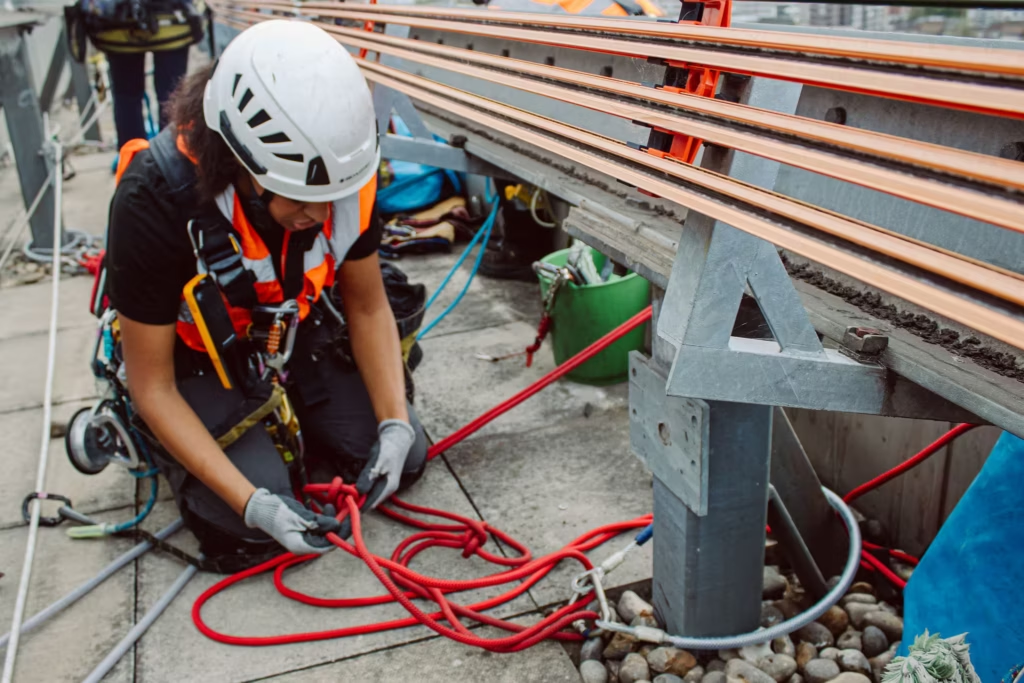
FM Managers and Surveyors are not expected to become rope-access technicians or fall-protection designers.
They do, however, need to appoint competent organisations and understand enough to challenge a proposal where important information is missing.
Under Regulation 8 of the Construction (Design and Management) Regulations 2015, organisations appointing designers and contractors must take reasonable steps to establish that they have the necessary skills, knowledge, experience and organisational capability.
Useful questions to ask before high-level work begins include:
How Has the Work-at-Height Hierarchy Been Applied?
Why has this particular access method been selected?
Could the work be completed without exposing somebody to a fall risk, or could collective protection or restraint be used instead?
Where Will Operatives Connect?
The proposal should identify where fall-protection or rope-access anchors are located and whether they are appropriate for the intended use.
Existing anchors should not simply be assumed to be suitable because they are already installed.
What Is the Worst-Case Fall Position?
The method should consider what happens when somebody moves around the work area.
Could they climb above an anchor? Could excess slack develop? Could they fall around an edge or swing into the structure?
What Fall Clearance Is Required?
The calculation should relate to the actual equipment, anchor locations and system configuration.
A generic clearance figure may not represent what happens on the building.
Are All Components Compatible?
Individual pieces of certified equipment do not automatically create a safe system when connected together.
Compatibility should form part of the equipment selection.
What Happens If Somebody Falls?
Stopping the fall is only the first part of the emergency.
There should be a workable method of reaching and recovering the casualty using the people and equipment available on site.
A generic risk assessment stating that “harnesses will be worn” does not answer these questions.
Why Rescue Planning Matters
A fall-arrest system is designed to prevent an operative reaching the ground or another lower level.
Once it has done that, the operative may be left suspended.
They could be injured, unconscious, unable to climb or located somewhere that cannot be reached using conventional building access.
Rescue therefore needs to be considered before work begins.
HSE guidance requires appropriate emergency and rescue arrangements for work at height. The plan should not rely on the fire and rescue service as the primary means of recovering the casualty.
Depending on the work, a rescue plan may need to identify:
- How the casualty will be reached
- How they will be released from the fall-arrest system
- Whether they will be raised or lowered
- What rescue equipment is required
- Who is competent to use that equipment
- How the emergency will be communicated
- How the rescue area will be controlled
- How occupants, the public and other contractors will be protected
The plan also needs to be achievable.
A rescue procedure that requires equipment which is not on site, or people who are not present, is not an effective rescue procedure.
Why High-Level Access Should Be Planned Early
The most serious consequence of poor work-at-height planning is injury or loss of life.
An incident can also have much wider consequences for the project and the organisations involved.
Work may need to stop while the site is made safe and investigated. Occupied areas could need to close. Programmes may be delayed and additional access or repair costs incurred.
There may also be:
- Enforcement action
- Insurance implications
- Claims and additional costs
- Tenant or occupier disruption
- Programme delays
- Damage to client relationships
- Reputational consequences
This is why access should not be left for the contractor to resolve when the team arrives on site.
The requirement should be considered during the survey, scoping and procurement stages.
Early planning provides more opportunities to compare access methods, identify unsuitable assumptions and design out problems before they become expensive site issues.
Common High-Level Access Planning Problems
Many access issues are predictable if they are reviewed early enough.
Examples include:
- Assuming an existing roof anchor is suitable without adequate information
- Specifying rope access before assessing the geometry of the façade
- Discovering that a fall-arrest system has insufficient clearance
- Missing fragile rooflights or surfaces during the initial survey
- Selecting an anchor position that creates a swing-fall hazard
- Providing no practical means of rescuing a suspended operative
- Appointing a contractor based on general experience rather than competence in the proposed access method
A minor assumption during tendering can become a major constraint once the project reaches site.
Understanding these requirements earlier allows access, safety, programme, cost and disruption to be considered together.
How Building Transformation Supports High-Level Projects
Building Transformation works with building owners, facilities teams, property managers, surveyors and wider project teams to plan and deliver roof, façade and difficult-access projects.
Access is considered as part of the project rather than as a separate issue to resolve after the technical work has been specified.
Depending on the project, this can include considering:
- How the work area can be reached
- Which access methods are practical
- Existing and proposed anchor arrangements
- Building and façade geometry
- Occupied areas and public interfaces
- Exclusion requirements
- Contractor competence
- Changing site conditions
- Emergency and rescue arrangements
The objective is to establish an access strategy that supports the technical work, building operation and safety requirements.
Early specialist input can also highlight where further surveys, testing or information are required before the contractor is appointed.
Building Competence Through CPD
Building Transformation also provides a CPD seminar on working at height and industrial rope access for facilities managers, surveyors, designers, project managers and other property professionals.
The purpose is not to train customers to undertake specialist access work themselves.
It is to help professional teams understand enough to review proposals and make better-informed decisions.
Topics include:
- The work-at-height hierarchy
- Work restraint, work positioning and fall arrest
- Industrial rope access
- Anchor position
- Fall factor
- Fall clearance
- Contractor competence
- Supervision
- Rescue planning
This will enable you to be in a better position to identify a well-considered access proposal and challenge one that depends on assumptions or incomplete information.
Choosing the Right High-Level Access Strategy
There is no single calculation or piece of equipment that makes work at height safe.
Fall factor is useful because it illustrates how the position of an anchor and the amount of free fall can change the severity of an incident.
But it is only one part of the system.
A suitable strategy also needs to consider:
- Whether work at height can be avoided
- Whether a fall can be prevented
- Anchor suitability and position
- Equipment compatibility
- Fall clearance
- Edge and swing-fall hazards
- Building geometry
- Operative competence
- Supervision
- Rescue
For FM managers, surveyors and property teams, the objective is not to carry out the technical calculations themselves.
It is to understand the principles well enough to identify when the proposed solution requires further investigation.
Speak to Building Transformation
High-level access should be planned alongside the roof, façade or maintenance work it supports.
Considering access, fall protection and rescue early can help identify constraints before they affect the programme, reduce late changes and provide greater confidence that the selected contractor and methodology are appropriate.
Building Transformation supports building owners, FM teams, surveyors and project teams with high-level inspections, specialist access, maintenance and repair projects.
Contact our team to discuss your roof, façade or difficult-access project and establish the most appropriate next step.

Frequently Asked Questions
What is fall factor?
Fall factor describes the relationship between the distance somebody can free fall and the length of active rope or lanyard available within the system. A higher fall factor generally represents a more severe fall condition.
What is a Fall Factor 0?
A Fall Factor 0 means there is effectively no free fall before the system becomes loaded. In practice, an overhead anchor with minimal slack can help create a near-zero fall-factor arrangement.
What is a Fall Factor 1?
A Fall Factor 1 can occur where the anchor is approximately level with the operative’s harness attachment point. The potential free fall may be approximately equal to the active length of the connecting system.
What is a Fall Factor 2?
A Fall Factor 2 can occur where somebody works above their anchor or connects at approximately foot level. In a simple configuration, the potential free fall can approach twice the active length of the connecting system.
Is an overhead anchor always Fall Factor 0?
No. Anchor position is only part of the calculation. A long or slack connecting system can still allow significant free fall even when the anchor is located above the user.
What is fall clearance?
Fall clearance is the total unobstructed distance required below an operative for a fall-arrest system to arrest a fall without the person striking the ground, structure or another obstacle.
Is fall arrest always required when working at height?
No. The work-at-height hierarchy requires work at height to be avoided where reasonably practicable. Where this is not possible, preventing a fall should normally be considered before relying on fall-arrest equipment.
Does a fall-arrest system need a rescue plan?
Yes. Rescue should be planned before work begins. The arrangements should reflect the actual working position, foreseeable fall scenarios, available rescue equipment and the competence of people on site.
Can FM managers or Surveyors rely on the contractor to choose the access method?
The contractor will normally provide specialist technical input, but those appointing and managing contractors still need to establish competence and satisfy themselves that the proposed arrangements are appropriate for the work.
What standards may apply to fall protection and rope access?
Relevant references can include the Work at Height Regulations 2005, BS EN 363:2018 for personal fall-protection systems, BS EN 355:2002 for energy absorbers, BS 8437:2022 for the selection, use and maintenance of personal fall-protection equipment, and BS 7985:2013 for industrial rope-access work. The standards applicable to a particular project depend on the access method, system and equipment selected.
