Curtain wall & glazing gasket replacement by abseiling – what does it involve, and when can it be employed?
This method typically involves a targeted approach to restoring failed gaskets on tall, complex, or difficult-to-access commercial façades.
Instead of relying on scaffolding, MEWPs or BMU (building maintenance units), IRATA-trained rope access technicians use specialist rope systems to reach the façade directly from above. From there, deteriorated gaskets can be removed, the interface cleaned and prepared, and new, correctly specified gaskets installed with minimal disruption to the building below.
For commercial property owners, facilities managers and surveyors, this matters because failed gaskets are a common cause of leaks, draughts, staining, air leakage and wider façade underperformance. If these issues aren’t resolved, a relatively localised gasket issue can quickly become a much larger building envelope problem.
So, let’s explore.
What are curtain wall & glazing gaskets?
Gaskets are the rubber or silicone seals used around units within a curtain walling, glazing or other façade systems. Their role is to help maintain weather-tightness, accommodate movement, and protect the internal façade components from moisture, air leakage, and environmental exposure.
In a properly functioning façade, gaskets work alongside sealants, drainage paths, pressure plates, fixings, mullions and transoms to keep the building envelope performing as designed.
When they fail, the building may not immediately show dramatic signs of damage. In many cases, the first indicators are subtle: staining around internal finishes, intermittent leaks during wind-driven rain, localised draughts, condensation, or small gaps visible around the glazing or panels.
The issue is that these symptoms are often misdiagnosed. Water ingress may appear internally several metres away from the point of failure, because water can track through the curtain walling system before emerging inside the building. This is why investigation, testing and accurate diagnosis are essential before replacement begins.
Common signs that gaskets need replacing
Gaskets naturally deteriorate over time due to UV exposure, weathering, movement, cleaning regimes and general façade ageing. In some cases, failure can be accelerated by incompatible materials, incorrect previous repairs or cleaning products that are not aligned with the original façade system.
Common signs of gasket failure include:
- Cracking, hardening or loss of elasticity
- Shrinkage around a glazing unit
- Gaps between the gasket and frame
- Detachment from the glazing or curtain walling system
- Water ingress or internal staining
- Air leakage and draughts
- Visible UV degradation
- Leaching of silicone or residue around the seal
Silicone leaching can also indicate that the wrong gasket system has been used, or that façade maintenance is being carried out with cleaning products incompatible with the building envelope.
Once the gasket is no longer able to maintain an effective seal, the façade becomes more vulnerable to water penetration, reduced airtightness, condensation risk, corrosion and damage to adjacent components.
Why failed gaskets should not be patched and ignored
Yes, patching seems like the quickest and maybe the cheapest solution, especially when the leak or other defects appear isolated. But with curtain walling and glazing systems, temporary repairs rarely restore the full integrity of the system.
A patch might stop visible water ingress for a short period, but it doesn’t necessarily address the reason the gasket failed, whether the profile is still performing, or whether adjacent components have also deteriorated.
Repeated patching also increases access costs. Every return visit requires planning, mobilisation, access provision and safety controls, and over time, reactive repairs can become more expensive than a properly planned replacement programme.
Correct gasket replacement via abseiling helps restore the façade’s weather tightness and airtightness, prevents secondary damage to frames and fixings, reduces the risk of internal damage, and supports the long-term performance of the curtain walling system.
Why abseiling is often the best access method
For many high-rise and complex commercial façades, abseiling provides a practical, efficient and low-disruption method of carrying out gasket replacement.
Scaffolding can be expensive, slow to install and disruptive to tenants, pedestrians and surrounding operations. MEWPs may not reach all areas, particularly where there are returns, restricted ground conditions, public realm constraints or difficult façade geometry. Building maintenance units can be useful where available and operational, but they are not always reliable, certified, maintained or able to reach every part of the building.
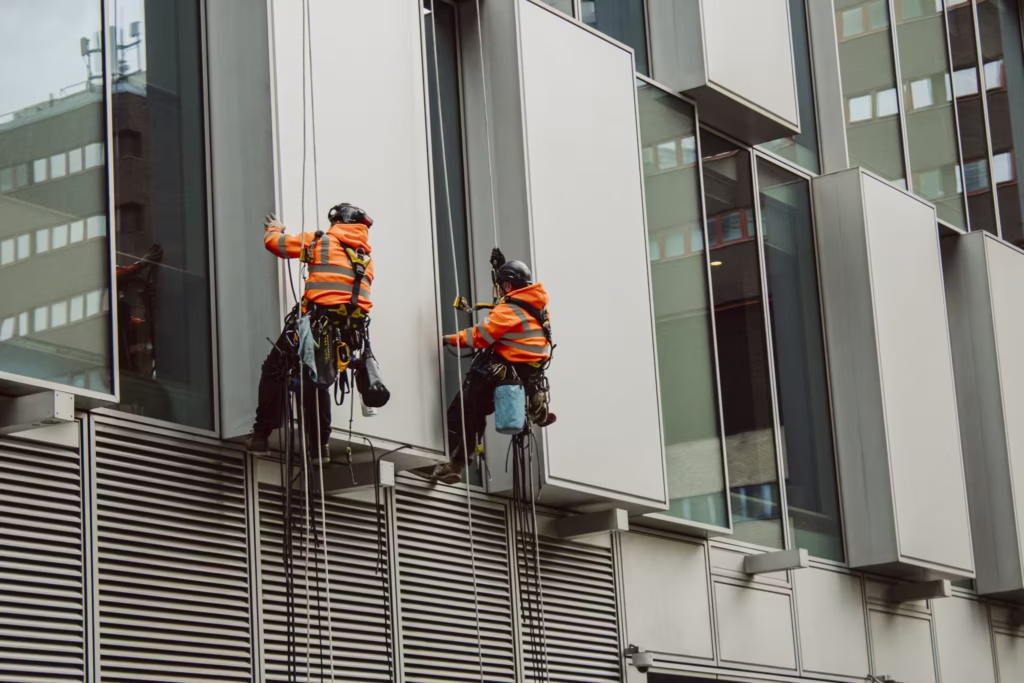
Rope access offers greater flexibility. Technicians can reposition quickly, work across multiple elevations and scale teams according to programme requirements. It is particularly effective where access is restricted at ground level or where the façade has areas that cannot be reached by fixed access systems.
At 5 Merchant Square, Building Transformation was appointed to complete large-scale façade refurbishment, leak investigation and repair works on a 14-storey office building in Paddington. The project includes gasket and sealant inspection and replacement, Curtain Walling Gaskets, Mullions & Sealant Maintenance, water ingress investigation, façade repairs and associated remedial works. Due to the restricted access around the building and the height involved, rope access provides a low-impact way to reach the façade while reducing the need for bulky ground-based access equipment.
What does gasket replacement by abseiling involve?
The process normally starts with inspection and investigation. Before replacement is specified, the existing gasket type, profile, material and failure mechanism need to be understood.
A typical gasket replacement by abseiling process may include:
- Access planning, risk assessment and method statement development
- Inspection of the curtain walling or glazing system
- Sampling of existing gasket profiles
- Review of O&M information, where available
- Identification of original manufacturer or supplier information
- Matching of gasket profile, material and geometry
- Removal of failed or deteriorated gaskets
- Cleaning and preparation of the interface
- Installation of new gaskets
- Inspection of adjacent sealants, fixings, drainage paths and glazing condition
Where the original gasket profile can be matched, replacement may be relatively straightforward. A sample can be sent to a supplier for comparison against standard extrusion catalogues. Where the original manufacturer is known, it may also be possible to confirm whether the original die still exists.
Where no match is available, a bespoke extrusion may be required. This is one of the areas clients often underestimate. Curtain wall gaskets are not generic rubber strips. The geometry, material, compression, movement tolerance and compatibility with the existing system all matter.
What needs to be understood before specifying a replacement gasket?
A successful replacement depends on understanding the existing system. This includes whether the façade is curtain walling, patent glazing, structural glazing or another system type.
The replacement also needs to account for thermal movement, structural movement, drainage and ventilation design, compatibility with adjacent sealants, and the condition of surrounding components.
If the wrong gasket is installed, the façade may still fail. It may not accommodate movement correctly, may not compress as intended, or may be incompatible with the existing frame, glass or sealant system.
This is why Building Transformation approaches gasket replacement by abseiling as part of wider façade diagnosis and remedial planning, not simply as a like-for-like installation task.
The value of early intervention
Early gasket replacement can prevent a relatively contained issue from escalating into major façade repair.
When water gets behind the external envelope, it can affect internal finishes, corrode metal components, compromise fixings, degrade adjacent materials and reduce the lifespan of the façade system. It can also cause disruption for tenants, particularly where leaks affect occupied commercial space.
A planned inspection and replacement programme allows works to be properly sequenced, costed and delivered. It also reduces the likelihood of reactive emergency callouts, repeated patch repairs and ongoing uncertainty for building managers.
For commercial façades designed to perform over many decades, small components such as gaskets play a significant role in long-term durability. Replacing them correctly helps restore the original function of the building envelope and protect the asset from avoidable deterioration.
Specialist gasket replacement for difficult-to-access façades
Curtain wall and glazing gasket replacement by abseiling is often the most efficient way to investigate and repair failed seals on high-rise, complex or access-constrained commercial buildings.
It reduces disruption, removes reliance on unreliable access systems, supports faster programme delivery and enables technicians to work directly where the defect exists.
For building owners, property managers and surveyors dealing with leaks, draughts or suspected curtain walling defects, the key is not just access. It is an accurate diagnosis, correct specification and careful delivery.
Building Transformation provides specialist curtain walling, gasket, mullion and sealant maintenance for commercial façades, using rope access and other façade access solutions to inspect, diagnose and repair difficult-to-access building envelope defects.