Maintaining tall commercial buildings is a tough and complicated job.
The higher the structure, the more complicated the access challenge tends to become.
Modern high-rise buildings often combine complex facades, live working environments, restricted ground-level space and difficult-to-reach plant or glazing areas, all of which make routine inspection, maintenance and repair far more demanding.
This is why working at height specialists play such a critical role. On tall and complex buildings, the question is not simply how to reach the work area. It is how to manage working at height safety efficiently and with minimal disruption to the people using the building every day.
For asset managers, facilities teams and surveyors, specialist access is often the key to progressing essential work where scaffolding or MEWPs are impractical, too disruptive or simply not suitable for the building. Rope access and abseiling are often the most effective methods, but success depends on far more than the access technique itself. It starts with careful working at height planning, an understanding of the building’s design and use, and a rescue strategy that is built into the project from the outset.
Why tall buildings need a different access strategy
Tall buildings present a very different set of challenges from lower-rise properties or simple working-at-height tasks. Height alone changes the level of planning required, but the real complexity often comes from the building itself.
Modern commercial facades may include extensive glazing, recessed elevations, stepped rooflines, atriums, plant zones, fragile elements, difficult parapet details or architectural features that restrict direct access. On many city centre buildings, especially in London, the surrounding environment adds another layer of difficulty. Busy public areas, restricted service yards, limited pavement space, neighbouring buildings, live traffic routes and occupied interiors can all affect how maintenance and inspection work is delivered.
In these situations, access planning must be tailored to the building rather than applied as a standard solution. The most effective strategy considers:
- the height and shape of the structure
- facade materials and design details
- roof access and anchor opportunities
- occupancy levels and public interface
- operational restrictions on site
- the type, location and urgency of the required works
This is why complex commercial buildings often require a working at height access specialist, not just a contractor with working at height equipment.
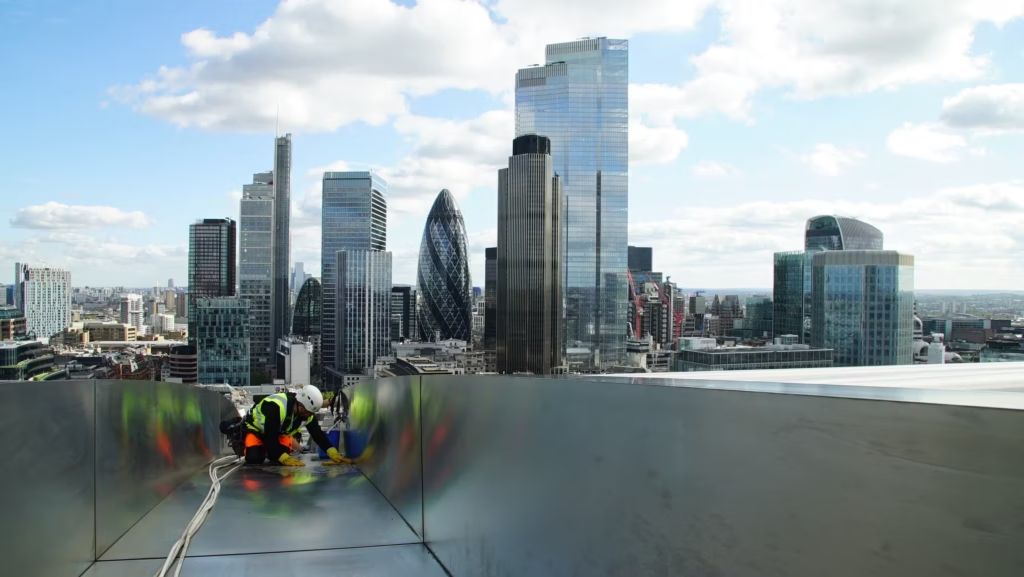
How do you access hard-to-reach areas on tall buildings?
On tall buildings, access is usually achieved by identifying the safest and most practical method for the specific area being inspected or repaired. In many cases, rope access and abseiling provide the best balance of working at height safety, flexibility and efficiency.
Unlike scaffolding, which requires significant build time, footprint and cost, rope access allows technicians to reach targeted areas directly. Unlike MEWPs, it is not dependent on clear ground-level positioning or suitable machine reach, which can be a major limitation on high-rise buildings in dense urban settings.
This makes rope access particularly effective for tasks such as:
- facade inspections
- high-level glazing surveys and repairs
- sealant replacement
- leak investigations
- localised facade repairs
- access to plant areas or roof-level details
- inspection of difficult junctions and recessed elevations
The value of rope access on tall buildings is not simply that it gets people to height. It is that it can often do so with less disruption, faster mobilisation and greater precision than other methods.
You can explore related services such as specialist access repairs and broader facade services where targeted access is essential to effective delivery.
When is rope access better than scaffolding or MEWPs?
There is no single access method that suits every building. The right approach depends on the structure, the task and the surrounding environment. However, on tall commercial buildings, rope access is often the preferred solution where speed, flexibility and minimal disruption are priorities.
Rope access is particularly well-suited where:
- The work is localised rather than full elevation
- Ground-level space is limited
- The building remains fully occupied during the works
- Access is needed to isolated or awkward facade areas
- A fast response is needed for inspection or reactive repair
- Scaffolding would be disproportionately costly or disruptive
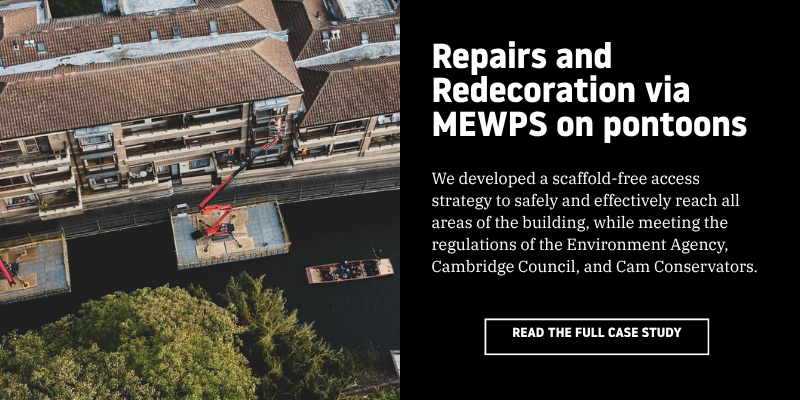
Scaffolding may still be appropriate where large areas of facade require prolonged hands-on work, or where heavy materials and extensive staging are needed. MEWPs may be suitable where ground conditions, reach, and site access allow. But on many tall buildings in London, those options are restricted by surrounding infrastructure, facade geometry or live operational constraints.
That is why the access decision should not start with a preferred method. It should start with the building, the risk profile and the nature of the work.
How working at height access planning is developed for complex tall buildings
The most important part of specialist access is often the planning that happens before anyone leaves the ground.
On tall buildings, access strategies are developed by assessing how the work can be carried out safely in a way that reflects the realities of the site. This usually includes reviewing available drawings, inspecting roof and facade conditions, identifying suitable anchor positions, understanding pedestrian and tenant interface, and determining what restrictions may affect delivery.
Planning typically considers questions such as:
- Where can technicians safely rig from?
- Which elevations or facade zones are accessible by rope?
- Are there restrictions around wind, weather exposure or drop zones?
- How will access be managed in a live commercial environment?
- What areas need exclusion zones or temporary controls?
- Is the work inspection-led, maintenance-led or repair-led?
- What rescue arrangements are required for the location?
This process is what separates working at height specialists from generic working-at-height activity. It is not just about sending operatives to a difficult area. It is about creating a safe, workable and efficient route to complete the job properly.
On complex buildings, that planning stage can make the difference between a workable solution and a costly false start.
Why is rescue planning essential for tall buildings
On tall and difficult-to-access buildings, rescue planning is not a box-ticking exercise. It is a core part of the working at height safety strategy.
Any work involving rope access or high-level positioning must consider what happens if a technician becomes unable to continue, if conditions change unexpectedly, or if an incident occurs while suspended or operating in a restricted area. The greater the height and complexity of the building, the more important the rescue strategy becomes.
A proper rescue plan considers:
- The exact working position and route of access
- The structure and facade features surrounding the work area
- The equipment and rigging arrangement being used
- How a casualty would be reached and recovered
- Who is carrying out the rescue, and what equipment is required
- How long would the recovery take in that specific scenario
- How the live building environment affects the rescue process
This is especially important on modern high-rise buildings where access routes may be indirect, roof arrangements may be complex, and the working area may be several storeys above occupied spaces or the public realm.
Effective rescue planning is built into the project from the start, not added later. It informs the choice of method, the rigging design and the sequence of works.

What site constraints affect access on occupied commercial building envelopes?
Many tall commercial buildings remain fully operational while inspection, maintenance, or repair work is underway. This creates a layer of live-environment constraints that must be actively built into the access plan.
In this context, the facilities or building manager plays a central coordinating role. Beyond managing the building fabric, they are responsible for protecting tenant operations, public safety, business continuity, and reputation. Their role typically includes:
- coordinating permits, access routes, and exclusion zones
- managing occupant communication and sharing critical service information
- reviewing contractor RAMS to ensure they reflect the live building environment, not just the generic task
- identifying and communicating known risks such as fragile zones, rooflights, plant areas, security constraints, and public interface challenges
Facilities teams and building managers therefore act as the key interface between the building and the works, ensuring that risks are understood in context and that disruption is controlled.
Common live-site constraints include:
- pedestrian routes and public interface
- tenant entrances and loading areas
- restricted out-of-hours working windows
- noise sensitivity
- visibility of works on prominent façades
- access restrictions in plant zones or roof areas
- coordination with security and building management teams
On these projects, the most effective access strategy is typically the one that achieves the technical objective while causing the least disruption to the building’s daily function. Rope access is often particularly valuable in these environments, as it reduces the physical footprint of the works and allows more targeted intervention.
This can be especially beneficial for issues such as leak detection, roof and gutter maintenance or high-level maintenance where quick, precise access is more useful than large-scale temporary works.
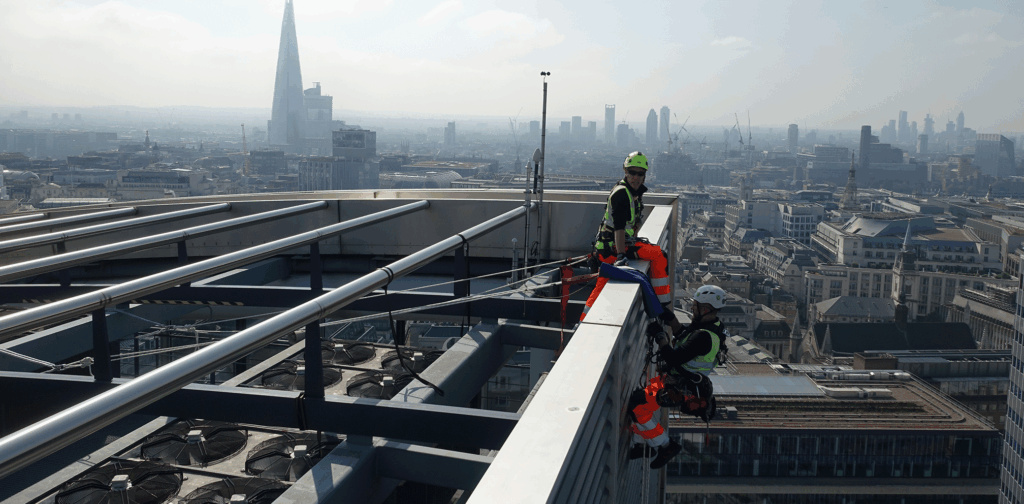
Real-world tall building access challenges
Modern high-rise buildings rarely offer simple access conditions. The difficulty often lies in the combination of height, design complexity and operational restrictions.
For example, a commercial building such as Merchant Square may involve extensive high-level glazing, modern facade interfaces and busy surrounding public space, all of which demand carefully controlled access arrangements. Buildings such as Moor House present similarly complex challenges, where significant height, dense city surroundings and live occupancy affect how inspection and maintenance works can be delivered.
Other scenarios may include:
- lift plant room access where routes are constrained, and roof-level working areas are limited
- facade inspection on stepped or recessed elevations
- access to high-level glazing or curtain wall details above active entrances
- localised maintenance near the roof plant or service zones
- inspection of hard-to-reach interfaces where leaks, movement or material failure are suspected
In each case, the access solution must respond to the building’s actual constraints. The priority is not just reaching the area, but doing so in a way that is safe, controlled and proportionate to the task.
Where working at height regulations fit into the process
Clients often search for terms such as working at height regulations, working at height safety or health and safety working at height, and understandably want reassurance that any proposed method is compliant.
For tall buildings, regulation matters, but it should support the main decision rather than dominate it. The real question is whether the chosen access method is suitable for the building, the work and the site conditions, and whether risks have been properly assessed and controlled.
That means considering the hierarchy of control working at height, selecting the most appropriate access system, ensuring competent personnel are used, and putting robust planning and rescue arrangements in place. On high-rise and technically difficult projects, compliance is not separate from delivery. It is embedded in the way the project is designed from the beginning.
When should you bring in working at height specialists?
If you are dealing with a tall commercial building where inspection, maintenance or repair cannot be easily achieved through conventional access methods, it is usually time to involve specialists early.
This is particularly important where:
- The building has a modern or complex facade
- Access to the required area is restricted or indirect
- The site is live, and disruption must be minimised
- There are concerns around leaks, glazing, facade condition or high-level defects
- A rescue strategy will be essential to safe delivery
- Previous access options have proved impractical or too costly
Early involvement allows access constraints to be assessed before time and money are lost pursuing the wrong approach. It also gives surveyors, FM teams and asset managers a clearer basis for decision-making.
Specialist access for tall buildings is about strategy, not just equipment
Tall buildings demand more than generic working-at-height equipment. They require a specialist working at height access strategy that reflects height, design complexity, site limitations and live operational conditions.
That is why working at height specialists are so important on modern high-rise buildings. The real value lies not only in the method of access itself, but in the planning behind it: understanding the building, selecting the right solution, controlling risk and building rescue planning into the project from the outset.
Where scaffolding or MEWPs are impractical, rope access and abseiling can provide a safe, efficient and highly targeted way to inspect, maintain and repair difficult-to-reach areas. But the success of that approach depends on experience, judgement and a clear understanding of how challenging buildings actually work.