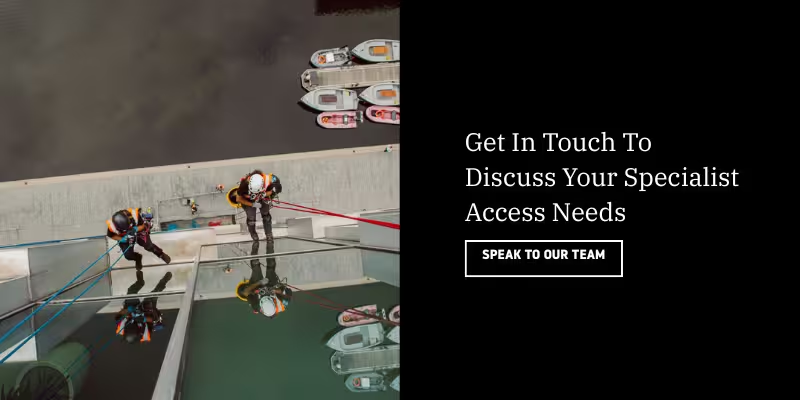
Specialist access plays a huge role in how we approach our projects. Not every building or structure can be reached with standard access equipment. So when maintenance needs to happen over roads, above lakes and rivers, on bridges, or across complex steel structures, access becomes a specialist discipline in its own right.
The challenge isn’t only getting to the workface. It is doing so safely, efficiently, compliantly and with a clear plan for inspection, repair, protection and long-term maintenance.
At Building Transformation, specialist access maintenance is built around exactly that principle. We combine access planning, inspection expertise, rigging design, safety management and repair delivery to help clients maintain difficult-to-reach assets with confidence. Our work spans the full lifecycle of a project, from testing and condition surveys through to specification development, remedial works, industrial coating removal, steel preparation and long-term repair strategies.
Why specialist environments need a different approach
Structures in unusual or high-risk environments place very different demands on a maintenance team.
Bridge maintenance over water, for example, introduces environmental controls, containment requirements, rescue planning, public safety considerations and access design challenges that simply do not exist on a standard commercial site.
Likewise, projects around sensitive façades, heritage structures, live operational settings, or restricted ground conditions often rule out traditional scaffolding or make it commercially impractical. In these cases, the success of the project depends on choosing the right combination of rope access, MEWPs, cradles, crane-assisted systems or temporary specialist rigging.
This is why specialist access maintenance must start with planning, not tools.
Every environment needs to be assessed in the round: the structure itself, the surrounding risks, environmental sensitivities, access constraints, operational requirements and the actual repair objective. Only then can the safest and most effective route to delivery be defined. Building Transformation’s approach is built around tailored methodologies, rigorous RAMS, rescue planning and access systems selected according to the risk profile and technical complexity of each project.
A full lifecycle approach to difficult-access maintenance
One of the biggest problems with complex structures is that maintenance is often approached too reactively.
A defect is found, access is arranged, a repair is made, and the wider asset strategy gets left behind. On specialist structures, that can be expensive. It can also mean clients are always reacting instead of planning ahead.
We will always take a more complete view. Our service offering covers access, survey and inspection, technical reporting, remedial repair works and longer-term maintenance planning. Condition surveys are used to capture structured data, identify defects, assess risk, and support prioritised decision-making. Findings can then feed into robust specifications for repair, corrosion treatment, recoating or broader maintenance programmes.
That matters particularly on steel structures. Where coating systems are breaking down, corrosion is often the visible symptom of a bigger maintenance issue. Detailed inspection, paint sampling and material analysis help establish the condition of the existing system, the extent of failure and the most appropriate route for repair or full coating replacement. This gives clients a stronger basis for budgeting, phasing and future planned preventative maintenance.
Safety planning is not an add-on
In specialist access work, safety planning is inseparable from delivery. It is not something layered on afterwards. It shapes the methodology from the outset.
Building Transformation’s specialist access projects are underpinned by project-specific RAMS, detailed rescue plans and in-house teams trained to recognised industry standards. The company’s rope access capability is supported by IRATA International Membership, while specialist access methodologies are adapted to suit each structure, whether that means controlled rope descent, MEWPs, cradle systems, BMUs or temporary engineered rigging.
This becomes even more important in environments where surrounding risks are heightened. Working above water, adjacent to live roads, around occupied buildings or in environmentally sensitive settings requires careful sequencing, containment planning, tool security, waste management and constant communication. Effective safety planning protects not just the workforce, but the public, the client’s operations and the long-term integrity of the asset.
Bridge maintenance demands technical rigging and steel corrosion expertise
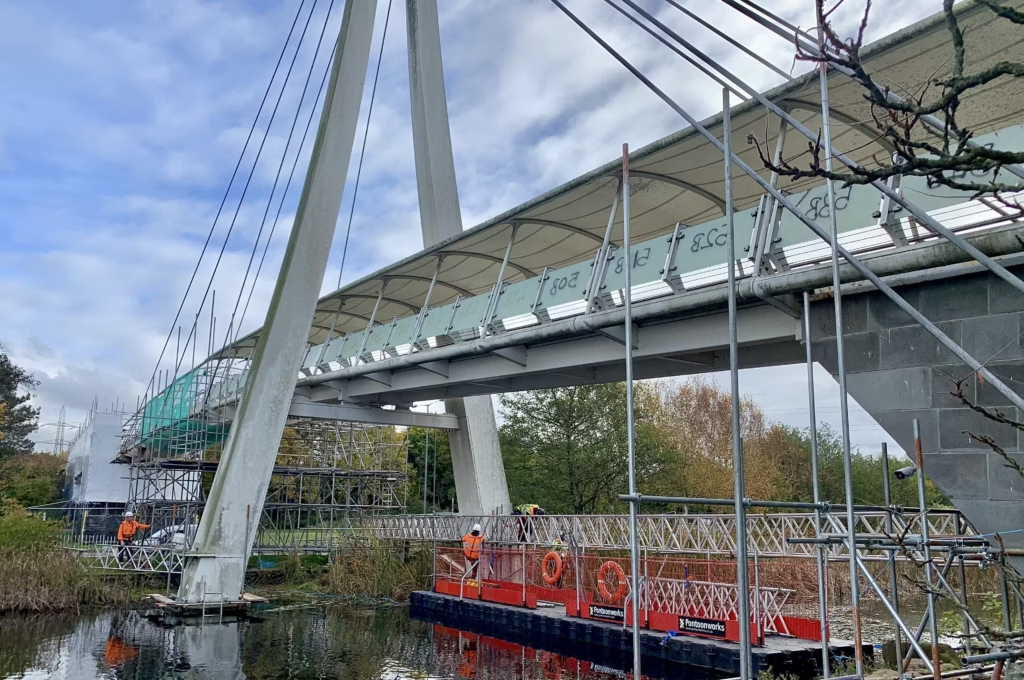
Bridge maintenance is one of the clearest examples of why specialist access matters.
These structures often combine height, exposure, difficult geometries, environmental sensitivity and ageing coating systems. Access is rarely simple, and the work itself often goes far beyond surface-level repair.
Building Transformation’s specialist bridge condition surveys are designed to safely inspect, measure and report on bridges, structures and masonry using a mix of rope access, cradles, MEWPs and crane-assisted systems as needed. Survey work can include corrosion surveys, paint sampling, defect mapping and other forms of targeted investigation, supported by digital data capture and, where needed, UKAS-approved laboratory analysis.
That technical understanding is critical when corrosion is present. Steel corrosion, failed coatings and substrate degradation need more than a cosmetic solution. The removal strategy depends on the coating system, substrate condition, structure, access restrictions and environmental sensitivities. In some cases, localised corrosion treatment and recoating via rope access is the right option. In others, full coating removal, surface preparation, and encapsulated working methods are required to achieve the specified result safely and in compliance.
Surface preparation is equally important. Industrial coating performance relies on proper steel preparation, whether that involves dry mechanical methods, rotary wire brushing, needle gunning, scraping, chipping, UHP water jetting or abrasive systems. Prepared surfaces are commonly brought to ISO 8501-1 St 3 standard, with quality control and paint thickness monitoring carried through the application process.
Specialist Access Maintenance in Action: Steel Bridge Refurbishment, Bristol
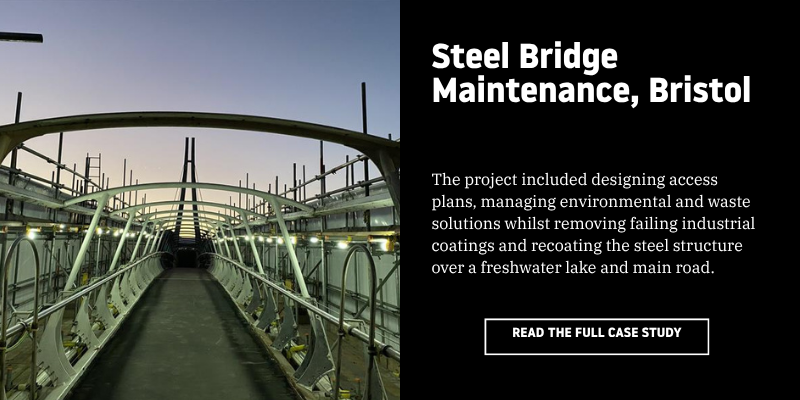
One of the clearest examples of this approach in practice is a steel bridge maintenance and industrial recoating project near Bristol, where Building Transformation was appointed to design and deliver a comprehensive refurbishment strategy for a pedestrian bridge that had been in service for more than 25 years. The structure serves as one of the primary pedestrian links on the site, meaning safe access planning, operational continuity and minimal disruption were central requirements from the outset.
The project scope extended well beyond coating application. It covered access strategy and planning, coating investigation and testing, surface preparation and coating removal, industrial coating application to a specified micron thickness, structural component replacement, including the canopy, guttering and balustrades, environmental management, and waste handling and compliance.
All of this was delivered above a freshwater lake and an active main road, making controlled access planning and environmental containment critical at every stage.
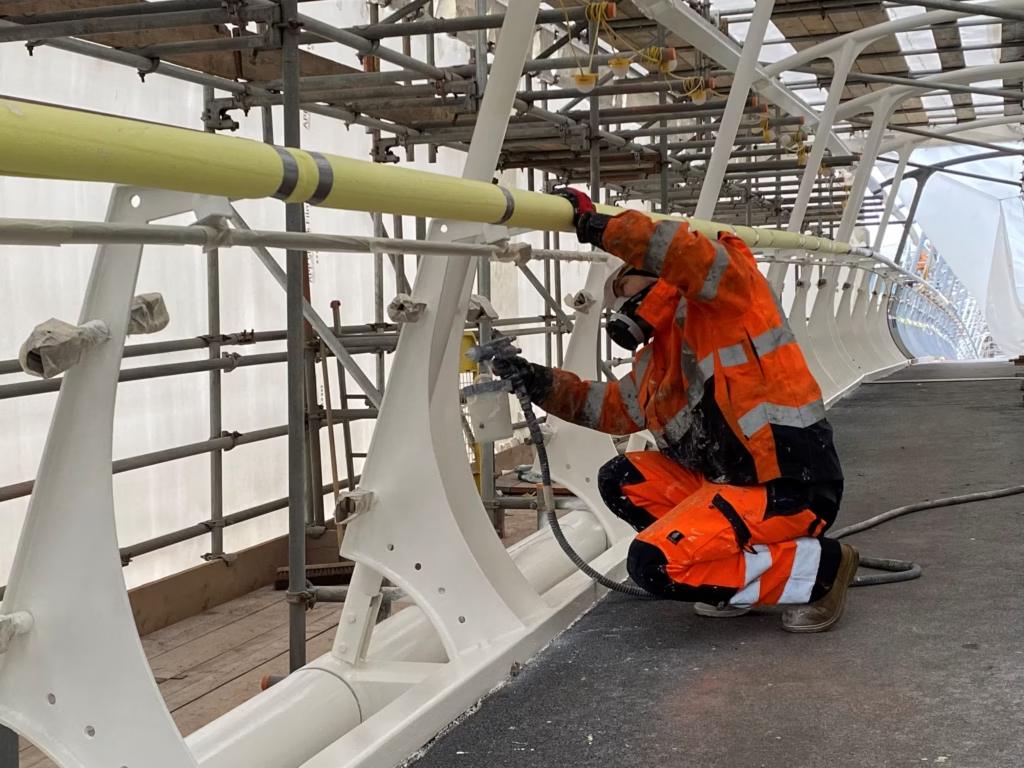
A key early stage was coating investigation and material analysis. Multiple samples were taken from across the structure and submitted for laboratory analysis to determine binder types, layer build-up and composition. That information was used to identify the most appropriate paint removal techniques, establish the sequencing of works, and specify a compatible, high-performance future coating system with confidence. This front-loaded technical work avoided the kind of reactive decision-making mid-programme that can cost time, budget and quality.
The removal and preparation phase required particular care. Paint removal methods were tested on-site to determine the most effective and controllable processes, including ultra-high-pressure water jetting, abrasive aggregate systems and ultra-heat-based techniques. Methods were selected and adapted to respond to the specific access constraints, environmental sensitivities and operational risks of working over water and alongside a live roadway. A significant part of the first phase was delivered at night, managing waste containment to ensure nothing entered the lake while maintaining a workable programme.
The result was a joined-up refurbishment; access, investigation, preparation, coating and structural repair treated as a single process rather than separate workstreams. It is a strong example of how bridge maintenance works best when technical planning, environmental control and industrial coating expertise are integrated from day one.
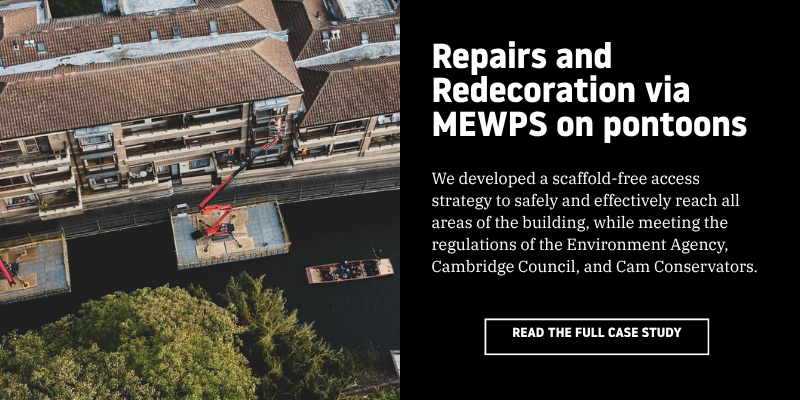
Façade maintenance above water: Beaufort Place, Cambridge
A different but equally specialist access maintenance challenge was delivered in Cambridge at Beaufort Place, where façade repairs and redecoration were completed using MEWPs positioned on purpose-built pontoons in the River Cam. The building’s riverside setting meant traditional scaffolding would have been intrusive and undesirable for the client, so Building Transformation developed an innovative scaffold-free access strategy that complied with the requirements of the Environment Agency, Cambridge City Council and the Cam Conservators. The works included façade cleaning, repainting, roof and gutter cleaning, and the installation of gutter protection to reduce future water ingress risk.
Both schemes reflect the same principle: specialist access maintenance is about solving the whole problem, not just reaching the surface.
Keeping clients informed and ahead of risk
For clients managing complex assets, one of the most valuable outcomes is clarity.
Specialist access maintenance work can feel opaque if information is not shared properly. Programmes become reactive, defects become surprises, and budgets are harder to control. That is why Building Transformation places so much emphasis on structured surveys, digital defect logging, clear reporting and risk-based prioritisation. Its condition survey process uses data-led reporting and RAG-rated prioritisation to help clients understand what needs immediate action, what can be planned and what can simply be monitored.
That approach helps remove uncertainty and keeps clients on the front foot. Instead of waiting for defects to escalate, they have the information they need to make earlier, better-informed decisions about repair budgets, project phasing and long-term maintenance priorities.
A responsive, proactive partner for complex specialist access maintenance
When maintenance has to happen in challenging environments, clients need more than a contractor. They need a rigging specialist and rope access maintenance company that is easy to work with, responsive in delivery, proactive in planning and innovative in solving access problems.