Access methods have a major impact on industrial maintenance projects. Affecting everything from programme speed, disruption, cost and safety planning. So making the correct choice from the outset is essential to the success and efficiency of a project.
Scaffolding has an important place on many industrial sites, particularly where large work areas, heavy materials or prolonged access are required. But it’s not always the most practical or efficient option, especially when the work is localised, time-sensitive or difficult to reach.
Industrial rope access is an alternative way to inspect, maintain and repair buildings, structures and high-level assets without automatically relying on large-scale scaffold installations. For facilities managers, asset managers, building surveyors, industrial site managers and main contractors, understanding the difference between rope access and scaffolding can help ensure the right access strategy is chosen from the start.

Rope access vs scaffolding: what’s the difference?
Rope access uses trained technicians, specialist equipment and controlled rope systems to reach areas that are difficult, high-level or awkward to access. It is commonly used for façade repairs, roof maintenance, gutter works, glazing repairs, inspections, industrial coating removal, steel preparation and other specialist access maintenance tasks.
Scaffolding involves building a temporary access structure around or alongside the asset. It can provide a fixed working platform for operatives, materials and equipment, and is often suitable for larger-scale works where repeated access is required over a longer period.
The right method depends on the building, the scope of works, the location, the risks involved and the level of disruption the site can tolerate.
| Factor | Industrial rope access | Scaffolding |
| Set-up time | Often faster to mobilise for targeted works | Usually requires more planning, installation and dismantling time |
| Disruption | Typically lower disruption to site operations, entrances and public areas | Can affect access routes, parking, operations and building use |
| Access capability | Strong for difficult, high-level, complex or localised areas | Strong for larger work zones and prolonged access |
| Cost efficiency | Often more cost-effective for short-duration or targeted works | Can be more cost-effective for large-scale, long-duration works |
| Flexibility | Technicians can move efficiently between areas | Access is fixed once the scaffold is installed |
| Best suited to | Inspections, repairs, cleaning, leak tracing, coating works and difficult access maintenance | Extensive repairs, heavy works, repeated access or multi-trade projects |
When rope access is typically used
Industrial rope access is typically employed when the access challenge includes height, complexity, restriction or disruption.
Examples include a façade defect on a high-level elevation, roof edge maintenance on a live commercial building, gutter repairs above operational areas, glazing works over an atrium, or industrial coating removal on steelwork where scaffold would be difficult, expensive or disruptive to install.
It can be particularly useful when the works are targeted, rather than spread evenly across an entire building. This way, rather than installing access across a whole elevation or structure, rope access teams can often reach the exact area requiring inspection, maintenance or repair.
Typical industrial rope access services include:
- Building and structural condition surveys
- High-level façade repairs
- Curtain walling gasket, mullion and sealant maintenance
- Roof and gutter repairs
- Atrium and glazing repairs
- Façade cleaning and restoration
- Leak investigation and diagnostic works
- Industrial coating removal and surface preparation
- Industrial steel painting and corrosion protection
- Difficult-access remedial works
Rope can, in many cases, help reduce scaffold dependency by giving clients a more focused route to inspection, maintenance and repair.
When scaffolding is typically used
But, scaffolding is still the right solution for many industrial maintenance projects.
It may be more appropriate when the works are extensive, where multiple trades need to work in the same area, where heavy materials need to be stored at height, or where the programme requires a fixed working platform for a longer period.
Scaffolding can also be useful when the same elevation or structure needs repeated access over several weeks or months. For example, a large façade refurbishment, full roof replacement or major structural repair programme may require scaffolding to create a stable and consistent working environment.
The key is not to treat scaffolding as the default for every high-level project. On many industrial buildings, there may be a more efficient way to access the asset, particularly when the works are localised, urgent or operationally sensitive.
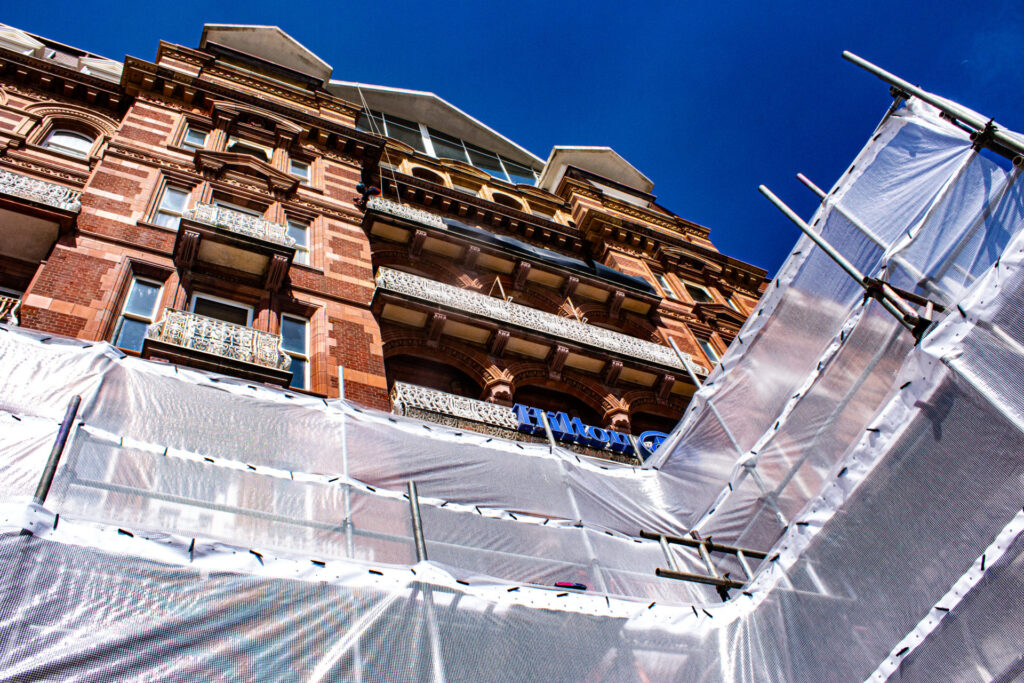
Comparing programme speed
One of the main advantages of rope access is speed of mobilisation. Scaffolding can require design, permissions, delivery, erection, inspection, adaptation and dismantling. Depending on the site, this adds significant time before the maintenance work itself can begin.
Rope access on the other hand can often be planned and mobilised more quickly, particularly for surveys, investigations, localised repairs and short-duration works. This can be especially valuable when a defect is causing water ingress, creating a safety concern or holding up a wider maintenance programme.
For industrial sites, faster access can mean faster diagnosis, faster remedial action and less time waiting for a full scaffold system to be installed before any meaningful work can begin.
Comparing operational disruption
Disruption is of course, a major consideration on industrial and commercial sites.
As we know, scaffolding can affect entrances, service yards, car parks, pedestrian routes, loading bays and operational areas. It may also create visual disruption, require exclusion zones, or interfere with other site activities.
Rope access is often less intrusive. Technicians can access specific areas from above, reducing the need for large structures at ground level. This can help keep buildings operational and reduce the impact on staff, visitors, tenants, customers and site logistics.
This is particularly important for live environments such as factories, warehouses, hospitals, hotels, offices, retail parks, transport hubs and education estates, where maintenance needs to be completed without unnecessary interruption.
Comparing access constraints
It’s important to note that not every building or structure is easy to scaffold.
Some industrial and commercial sites have limited ground space, fragile surfaces, public interfaces, plant equipment, watercourses, roof-level obstacles, live operations or complex elevations. In these environments, scaffolds may be difficult to install or may create additional risk and disruption.
Rope access can provide a practical solution for areas that are difficult to reach using traditional methods. It allows trained technicians to work on high-level, confined, awkward or restricted areas where scaffold or MEWPs may be limited.
This can be especially useful for façade and curtain walling maintenance, roof edge works, atrium glazing repairs, industrial coating removal, bridge maintenance and building envelope inspections.
Comparing safety considerations
Is rope access safer than scaffolding?
The honest answer is that both rope access and scaffolding can be safe when properly designed, planned and delivered by competent professionals. Neither method should be treated casually.
Scaffolding safety depends on correct design, erection, inspection, edge protection, loading, site controls and ongoing management. Rope access safety depends on trained operatives, detailed planning, rescue procedures, equipment checks, anchor points, exclusion zones and appropriate supervision.
The safest method is the one that suits the task, site conditions and risk profile.
For certain industrial maintenance projects, rope access may reduce some risks associated with scaffold installation, ground-level obstruction, extended programme duration or working around live operations. However, it still requires specialist planning and should only be delivered by experienced rope access professionals with the right systems and procedures in place.
Comparing cost efficiency
Is rope access cheaper than scaffolding?
Rope access can often be more cost-effective than scaffolding for targeted, short-duration or difficult-access maintenance projects because it can reduce the need for large temporary access structures. This may lower costs associated with scaffold design, hire, installation, adaptation, inspection and dismantling.
However, that doesn’t make rope access automatically cheaper in every situation.
If a project involves extensive repairs across a large area, multiple trades, heavy materials or a long programme of work, scaffolding may be the more practical and cost-effective choice.
The best approach is to assess the total project cost, not just the access cost. This includes mobilisation, programme duration, disruption, site restrictions, operational downtime, safety planning and the risk of delays.
Rope access for industrial maintenance projects
Industrial maintenance often involves working on buildings and structures that were not designed with easy access in mind.
High-level façades, rooflines, glazing systems, gutters, steelwork, plant areas, bridges, hangars and complex industrial structures can all present access challenges. In these situations, industrial rope access allows maintenance teams to reach the asset directly and carry out targeted works with less reliance on scaffold.
Rope access is often used as part of a wider specialist access strategy. This may involve combining rope access with other methods where required, depending on the building, structure and scope of works.
Our specialist access teams support maintenance across façades, roofs and complex structures, including specialist access services, façade maintenance, roof services, curtain walling gasket and sealant maintenance, façade cleaning, atrium and glazing repairs, specialist access maintenance, industrial coating removal and industrial coatings.
This means the access method is considered alongside the technical requirement, not separately from it.

Choosing the right access method
The right access method should be based on the building, the works and the operational environment.
Before choosing between rope access and scaffolding, it is important to consider:
- What work needs to be carried out?
- Is the work localised or spread across a large area?
- How quickly does access need to be arranged?
- Will the building remain occupied or operational?
- Are there public areas, entrances or live site operations below?
- Are there restrictions around ground space, plant, rooflines or neighbouring properties?
- Will multiple trades need to work in the same area?
- Are heavy materials or equipment required?
- How long will the access be needed?
- What is the safest and most efficient way to complete the work?
In many cases, the answer is not simply rope access or scaffolding. It may involve a combined access strategy that uses the most appropriate method for each part of the project.
For example, scaffold may be used for a larger work zone, while rope access is used for targeted inspections, hard-to-reach repairs or areas where scaffold would be impractical. This can help improve efficiency, reduce unnecessary scaffold dependency and keep the project focused on the actual maintenance outcome.
Pros and cons of industrial rope access
| Pros | Cons |
| Fast mobilisation for targeted works | Not always suitable for heavy materials or large work zones |
| Reduced disruption to occupied or operational sites | Requires trained and competent rope access technicians |
| Effective for difficult-access areas | Anchor points and rescue planning must be assessed |
| Can reduce scaffold dependency | Weather and site conditions may affect delivery |
| Useful for inspections, repairs and maintenance | May need to be combined with other access methods for wider projects |
Pros and cons of Scaffolding
| Pros | Cons |
| Provides a fixed working platform | Can take longer to design, install and dismantle |
| Useful for large or long-duration projects | May cause more disruption at ground level |
| Can support multiple trades | Can affect entrances, access routes and operations |
| Suitable for some heavy works | May be expensive for small or targeted works |
| Provides repeated access to the same area | Less flexible once installed |

FAQs
What is industrial rope access?
Industrial rope access is a specialist method of reaching high-level, restricted or difficult-access areas using ropes, harnesses and controlled access systems. It allows trained technicians to inspect, maintain and repair buildings, façades, roofs, steelwork, glazing and other structures without always needing scaffolding or MEWPs.
Is rope access cheaper than scaffolding?
Rope access can be cheaper than scaffolding for targeted, short-duration or difficult-access works because it can reduce the need for scaffold design, installation, hire and dismantling. However, scaffolding may be more cost-effective for large-scale, long-duration or heavy works where a fixed platform is required.
Is rope access safer than scaffolding?
Rope access and scaffolding can both be safe when properly planned and delivered by competent professionals. The safest method depends on the project, site conditions, access requirements and risks involved. Rope access may reduce some disruption and ground-level risks, but it still requires specialist planning, trained technicians and robust safety procedures.
When should rope access be used instead of scaffolding?
Rope access is often a strong option when works are localised, difficult to reach, urgent, or likely to cause significant disruption if scaffold is installed. It is commonly used for façade repairs, roof maintenance, gutter works, glazing repairs, leak investigations, surveys, industrial coating removal and targeted remedial works.
When is scaffolding the better option?
Scaffolding may be better for large-scale works, long-duration programmes, heavy repairs, multi-trade projects or situations where a fixed working platform is required for repeated access.
Can rope access and scaffolding be used together?
Yes. Many maintenance projects benefit from a combined access strategy. Rope access can be used for targeted areas, inspections or difficult-access sections, while scaffolding may be used where larger work zones or prolonged access are required.
Need help choosing the right access method?
If you are planning an industrial maintenance project and need to understand the most practical way to access your building or structure, Building Transformation can help.
Our team can assess the site, identify access constraints, review the scope of works and recommend a safe, efficient and technically suitable access strategy.
Whether your project requires rope access, scaffolding, MEWPs or a combined approach, we focus on reducing disruption, improving access efficiency and delivering the right maintenance outcome for your asset.
Speak to our expert team about your industrial rope access and specialist maintenance requirements.
