New leaks, recurring problems and storm-related damage: understanding what the recent weather may have revealed about your building.
Recent storms, strong winds and persistent rainfall have put building envelopes under considerable pressure. For some buildings, the weather may have caused new damage or exposed previously unnoticed defects. For others, it may have brought familiar leaks and water ingress back to the surface or made existing problems significantly worse.
While the immediate priority is often to stop water entering the building, understanding WHY the problem has occurred is essential to delivering an effective, lasting repair.
From damaged roofing and overwhelmed drainage systems to failed façade seals and concealed waterproofing defects, adverse weather can reveal vulnerabilities across the building envelope.
What Can Heavy Rain and Storms Reveal About Your Building?
A building may perform adequately during normal rainfall but develop problems when exposed to prolonged or more severe weather.
Sustained rainfall, strong winds and repeated wetting can place additional demands on roofing systems, façades, glazing and drainage. Water may enter through defects that have existed for some time without producing obvious internal symptoms.
Some of the most common issues include:
Damaged Roofing and Failed Waterproofing
Roof coverings are exposed to significant weathering throughout the year. Strong winds can displace or damage roofing materials, while sustained rainfall may exploit weaknesses in ageing waterproofing systems.
Areas particularly vulnerable to water ingress include:
- Damaged or displaced tiles and slates
- Split or deteriorated waterproofing membranes
- Failed flashings and leadwork
- Roof penetrations and plant interfaces
- Parapets, upstands and perimeter details
- Rooflights and junctions between different materials
The source of a leak is not always immediately obvious. Water can travel beneath roof coverings or through the building structure before appearing internally, sometimes some distance from the original defect.
A detailed roof inspection, supported by specialist testing where necessary, can help identify the underlying problem and establish the appropriate repair.
Blocked Gutters and Overwhelmed Drainage Systems
Heavy rainfall can quickly expose problems with roof drainage.
Blocked outlets, accumulated debris, damaged gutters and poorly performing rainwater systems can prevent water from draining effectively. This may result in standing water, overflowing gutters or water backing up against vulnerable roof and façade details.
Common warning signs include:
- Water ponding on flat roofs
- Gutters overflowing during rainfall
- Water staining on external walls
- Damp patches appearing near roof edges
- Leaks occurring only during particularly heavy rain
Not every drainage problem requires major remedial work. In some cases, clearing debris, repairing damaged sections or restoring effective drainage can significantly reduce the risk of further water ingress.
However, recurring problems may indicate a more substantial issue with drainage capacity, roof falls or the condition of the system.
Explore our roof maintenance and repair services.
Failed Façade Sealants and Glazing Interfaces
Water ingress is not always a roofing problem.
Wind-driven rain can penetrate weaknesses in façades, curtain walling, glazing systems and movement joints, particularly where sealants or gaskets have deteriorated.
These components are designed to accommodate movement while maintaining the weather resistance of the building envelope. Over time, exposure to temperature changes, UV and general weathering can cause them to shrink, crack, separate or lose elasticity. This could have been exacerbated during the heatwaves this summer.
Potential warning signs include:
- Water staining around windows or curtain walling
- Damp patches on internal walls
- Leaks that occur primarily during wind-driven rain
- Deteriorated or missing sealants
- Displaced glazing gaskets
- Water ingress around façade penetrations or interfaces
Identifying the source can be particularly challenging on tall or complex buildings, where access is restricted and water may travel through concealed cavities before becoming visible.
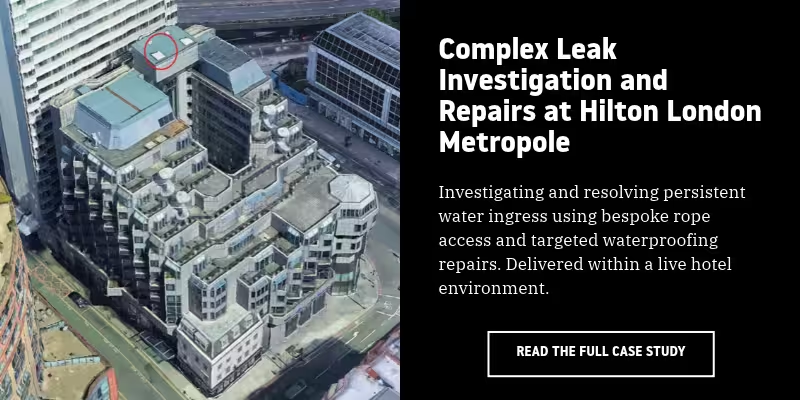
Specialist access methods, including rope access, enable close-range inspections and targeted investigations without necessarily requiring extensive scaffolding.
Why Do Some Leaks Keep Coming Back?
One of the most frustrating consequences of prolonged rainfall is the return of a leak that was thought to have been resolved.
A previous repair may have temporarily stopped the visible water ingress without addressing the underlying defect. Alternatively, the repair may have been effective, but deterioration elsewhere in the building envelope has created a new pathway for water.
Recurring leaks can be particularly difficult to diagnose because the location where water appears internally is not necessarily where it enters the building.
Water can travel through roof build-ups, structural elements, cavities and internal finishes before becoming visible.
This means that repairing the area directly above a damp patch or stained ceiling may not resolve the problem.
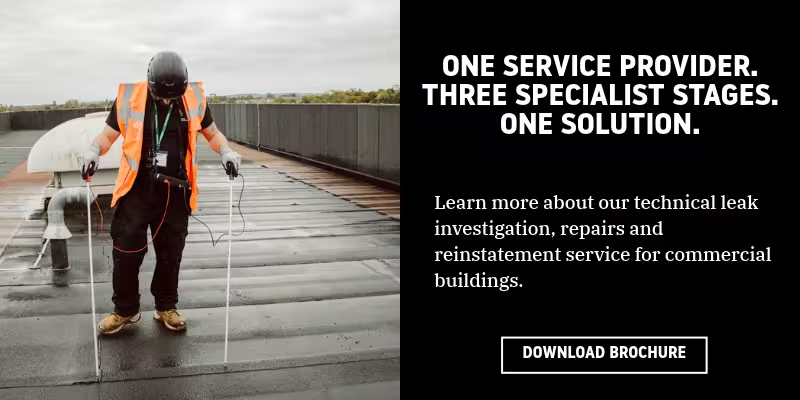
Where previous repairs have been unsuccessful, a structured leak investigation can help eliminate assumptions, isolate potential sources and identify the actual route of water ingress.
Case Study: Tracing a Persistent Roof Leak at a Primary School
Building Transformation was appointed to investigate recurring water ingress affecting an internal corridor at a primary school in Berkshire.
The source of the leak was unclear, with both the gutter and adjacent roof-edge detailing considered potential causes.
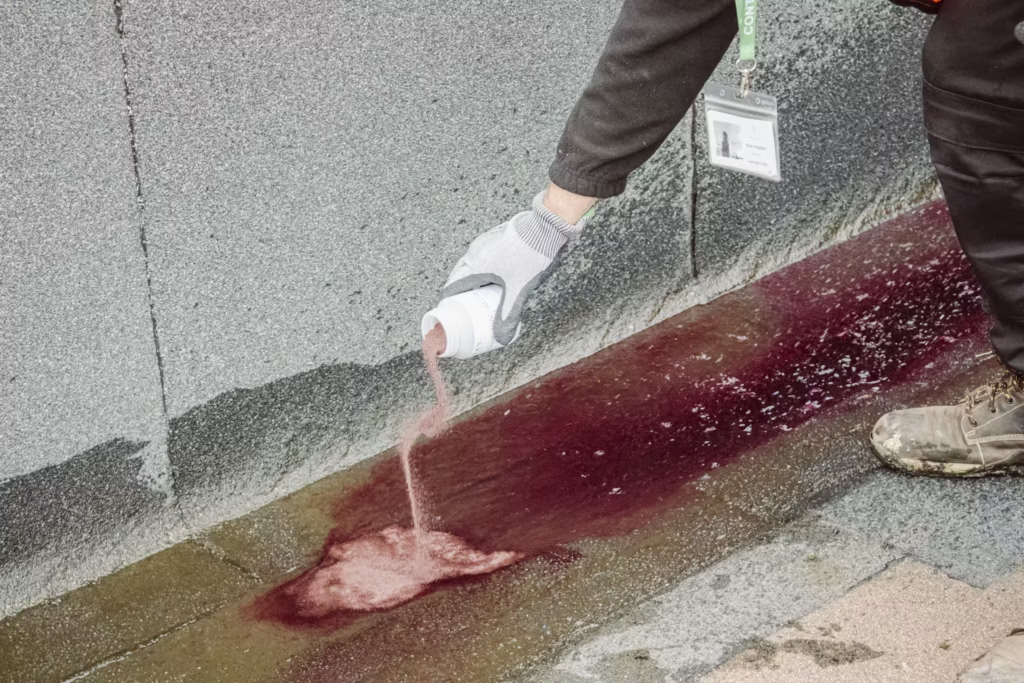
Our team used a combination of fluorescent dye testing, controlled rainfall simulation, thermal imaging, moisture testing and internal ceiling-void inspections.
Testing established that the gutter was watertight and identified defective GRP roof-edge detailing as the source of the water ingress.
Importantly, water took approximately eight to nine hours to travel through the building construction before becoming visible internally.
The investigation provided the client with a clear diagnosis and targeted remedial recommendations, avoiding unnecessary repairs to unaffected areas of the roof.
Read the full roof leak investigation case study.
Investigate First, Repair with Confidence
When dealing with complex or recurring water ingress, identifying the root cause should come before specifying permanent repairs.
At Building Transformation, our investigations combine building envelope expertise with specialist diagnostic techniques to establish how and where water is entering a building.
Depending on the construction, suspected defect and site conditions, investigations may include:
- Electronic leak detection: Helping identify breaches in suitable waterproofing systems.
- Thermal imaging and moisture mapping: Supporting the identification of moisture-affected areas and concealed water ingress.
- Controlled water testing: Reproducing rainfall conditions to isolate potential entry points.
- Dye testing: Helping trace water movement and distinguish between suspected sources.
- Close-range inspections: Assessing roof details, façade interfaces, sealants and glazing components.
- Borescope investigations: Examining concealed areas where direct inspection is difficult.
The objective is to provide clear evidence of the defect, its likely cause and the remedial work required.
Learn more about our water ingress investigation and leak detection services.
From Investigation to Remedial Repairs
Identifying the source of water ingress is only part of the solution.
Once the defect has been established, the next step is to determine the most appropriate repair strategy, considering the condition of the building, access requirements, operational constraints and long-term performance.
Building Transformation provides an integrated service covering investigation, specialist access and remedial works.
Our capabilities include:
- Roofing repairs and waterproofing
- Liquid-applied waterproofing systems
- Flashing and leadwork repairs
- Gutter and rainwater drainage maintenance
- Façade sealant and movement joint replacement
- Curtain walling and glazing repairs
- Planned roof and building envelope maintenance
By combining these services, we can support clients from initial investigation through to delivering the necessary repairs, reducing the need to coordinate multiple specialist contractors.
What Should Building Managers Do Following Severe Weather?
Following a period of heavy rainfall or strong winds, it is worth reviewing whether any new issues have developed or existing problems have changed.
Practical steps include:
- Record new or recurring leaks. Note when water ingress occurs, where it appears and whether it is associated with particular weather conditions.
- Check for visible signs of damage. Look for staining, displaced materials, overflowing gutters or other indications of deterioration from safe locations.
- Review previous repairs. If a leak has returned, establish what work was previously undertaken and whether the original cause was conclusively identified.
- Arrange specialist inspection where required. Roofs, high-level façades and other difficult-access areas should be assessed by appropriately trained personnel.
- Prioritise remedial works. Address defects presenting immediate risks and establish a planned approach to less urgent maintenance.
Where there is evidence of loose materials, structural damage or unsafe conditions, affected areas should be made safe and assessed by competent specialists. Roof access should not be attempted during unsafe weather conditions.
Protecting Your Building Beyond the Immediate Repair
Although adverse weather often prompts reactive maintenance, it can also provide valuable information about the wider condition of a building.
A leak investigation or post-storm inspection may reveal other areas requiring attention, such as deteriorating sealants, ageing waterproofing or drainage systems that would benefit from regular maintenance.
Addressing these issues through a planned building envelope maintenance programme can help reduce unexpected disruption, prioritise expenditure and extend the service life of building components.
The aim is not simply to respond when something fails, but to understand where risks are developing and manage them before they become more serious.
Has the Recent Weather Exposed a Problem with Your Building?
Whether you are dealing with a new leak, a recurring issue that has resurfaced following heavy rainfall, or suspected storm-related damage, Building Transformation can help.
Our specialist teams investigate water ingress across roofs, façades, glazing and complex structures, combining technical diagnosis, tailored access solutions and targeted remedial repairs.
Don’t wait for the next period of heavy rainfall to make the problem worse.
Contact Building Transformation to discuss your building, or call 01234 589807 to speak to our team.