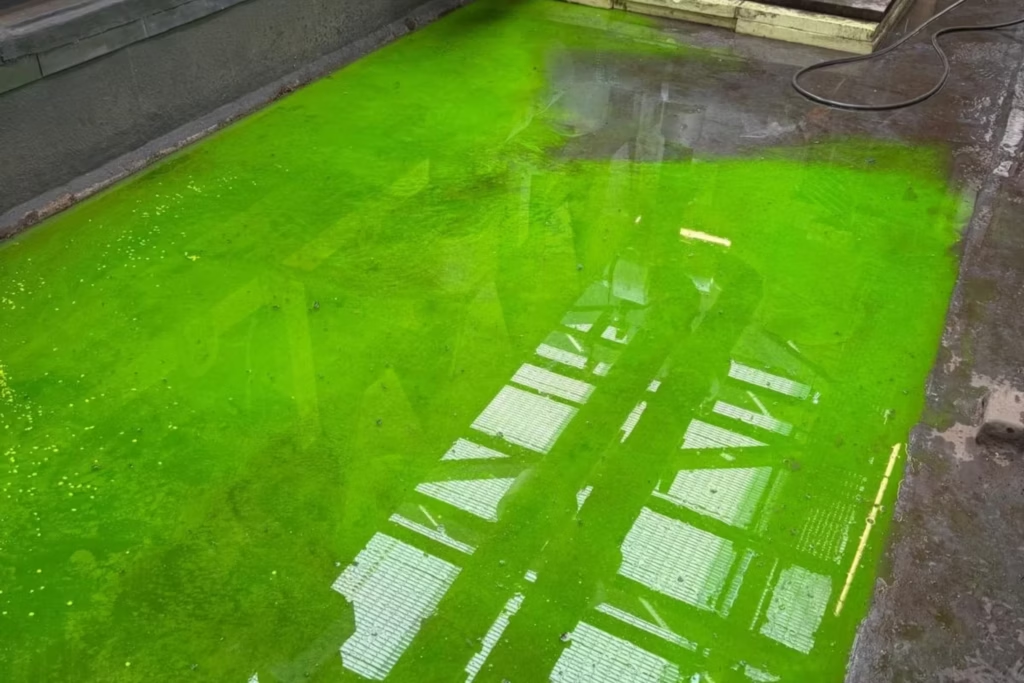
A roof flood test involves temporarily retaining water over a defined area of waterproofing to check for water penetration. In suitable circumstances, it can help assess whether a section of the roof is allowing water into the building.
However, flood testing has limitations. It may demonstrate that water is passing through the tested area without identifying the precise defect or the route it takes through the roof construction.
Before testing, the roof’s condition, structural capacity, drainage arrangements and the potential consequences of leakage must be assessed. Flood testing should only be considered where it is appropriate for the roof and can be carried out under a controlled testing plan.
How does a roof flood test work?
A defined area of the roof is temporarily isolated and water is introduced under controlled conditions. The area below is monitored for signs of water penetration throughout the test.
Water depth and test duration must be determined for the specific roof, taking account of its construction, falls, waterproofing system, upstand heights and allowable loading. A single depth or duration is not suitable for every building.
Before work begins, the testing plan should address:
- Whether the roof can safely support the additional water load.
- How water will be contained without overwhelming vulnerable details.
- How the areas below will be accessed and monitored.
- How the test will be stopped if leakage occurs.
- How water will be removed safely, including emergency arrangements.
- Whether drainage systems can accommodate the controlled discharge.
A preliminary roof condition survey can help establish the condition of the roof and whether further testing is appropriate.
What are the limitations of flood testing?
It may not identify the exact defect
Water appearing inside the building confirms penetration under the test conditions, but its entry point may be some distance away. Water can travel through insulation, roof build-ups and structural interfaces before becoming visible.
Further leak detection and water ingress investigation may therefore be needed to locate the source and specify an effective repair.
It can introduce water into the roof construction
Where defects are present, testing may wet insulation, the deck or internal finishes. Trapped moisture can create further maintenance problems, so the potential consequences must be considered before introducing water.
Coverage can be uneven
Roof falls and surface irregularities mean that water depth varies across the test area. Higher sections may receive insufficient coverage while lower areas experience greater loading.
On inverted roofs or roofs with existing finishes, the build-up can also make it difficult to establish which areas and details have been effectively tested.
A successful test has limits
An absence of visible leakage does not establish that every joint, detail or interface is defect-free. Flood testing does not reproduce all the conditions that can cause water ingress, such as wind-driven rain.
It should be considered alongside inspection findings and other diagnostic evidence.
Potential advantages of roof flood testing
Where the roof and circumstances are suitable, flood testing can:
- Help assess a defined area of waterproofing under controlled conditions.
- Support the investigation of suspected water penetration.
- Sometimes be undertaken with existing finishes in place, subject to the roof build-up and testing objectives.
Potential disadvantages of roof flood testing
Limitations and risks include:
- Additional loading on the roof.
- Possible damage to insulation, the roof deck and internal spaces.
- Limited information about the precise location of a defect.
- Uneven coverage across roofs with falls or irregular surfaces.
- The need for careful monitoring and controlled water removal.
- Unsuitability for pitched roofs and some other roof constructions.
- Weather conditions affecting the control or interpretation of the test.
Are there alternatives to flood testing?
The most appropriate investigation depends on the roof construction, waterproofing material, access arrangements and reported problem.
Our leak detection surveys can combine diagnostic techniques to build a clearer picture of the cause and extent of water ingress.
Depending on suitability, these may include:
- Electronic leak detection: locating breaches in compatible waterproofing systems.
- Thermal imaging and moisture mapping: identifying patterns that may indicate moisture within the roof build-up.
- Controlled water or dye testing: investigating suspected entry points and water pathways.
- Borescope investigations: examining concealed areas where access allows.
Each technique has limitations. Selecting the right combination helps avoid relying on a single result when deciding what repairs are needed.
How Building Transformation can help
Resolving a roof leak starts with understanding why it is happening.
Building Transformation combines inspections, diagnostic testing and specialist access to investigate water ingress across roofs, façades, glazing and difficult-to-reach building interfaces.
Our roof condition surveys help establish the wider condition of the roof, while targeted investigations help determine the source of reported leaks.
Once the problem is understood, our roof repair and maintenance services can help address defects and protect the remaining serviceable roof.
For buildings with ongoing maintenance needs, a planned preventative maintenance programme can bring together inspections, drainage maintenance, defect monitoring and prioritised remedial works.
Whether you need to investigate a recurring leak or assess your roof before planning repairs, our team can help identify the appropriate next step.