When maintaining, repairing, or cleaning tall or complex buildings, the access strategy (i.e. Rope Access vs Scaffolding vs MEWPs) is not a minor detail; it directly affects cost, safety, programme duration, and public disruption.
The main options available for difficult-to-access buildings are scaffolding, rope access, and mobile elevating work platforms (MEWPs). Looking at each in turn should give you a better understanding of their benefits, and if you aren’t sure which is right for your building, just get in touch, and our experts can help.
This blog will help you compare the three across the factors that matter most.
Rope Access: Minimal Disruption, Maximum Flexibility
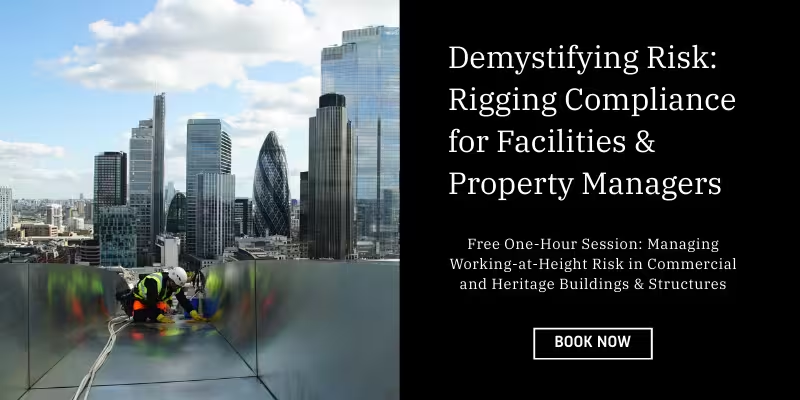
Rope access (sometimes referred to as industrial abseiling) is a popular choice for many difficult-access maintenance and façade-cleaning projects, particularly when buildings are tall, occupied, or historically sensitive.
Instead of building a temporary structure, technicians work directly from ropes, using certified anchor systems and safety lines.
Advantages of Rope Access
- Lower overall cost for short-duration works
Rope access typically has lower upfront costs than scaffolding and can be more economical than MEWPs on taller buildings. There is no need for extensive groundwork, transport logistics or prolonged hire periods. - Speed and daily efficiency
Because there is minimal setup, work can often begin almost immediately. This makes rope access ideal for reactive maintenance, surveys, inspections and targeted repairs. - Reduced impact on occupants and the public
There is no physical structure enclosing the building. Entrances remain open, pavements are often unaffected, and visual disruption is minimal, particularly valuable for hotels, offices, retail and public buildings. - Excellent for façade-led works
Rope access is well-suited to façade inspections, glazing checks, sealant repairs, localised masonry works and scaffold-free façade cleaning.
Limitations of rope access
- Rope access relies on suitable anchor points or temporary systems
- It is weather-dependent, particularly in high winds
- It is less suitable for tasks requiring constant heavy material handling or large tools over long periods

Scaffolding: Stability for Long-Term or Multi-Trade Projects
Scaffolding remains a valid and sometimes necessary solution, particularly when works are extensive, complex, or requires multiple trades to operate simultaneously.
For older or architecturally complex buildings, scaffold design must be handled carefully to avoid damage to façades or historic fabric.
Advantages of scaffolding
- Best for long-duration projects
If works are expected to last weeks or months, scaffolding can become cost-effective over time, especially when large-scale, multiple repair stages are involved. - Stable working platform
Scaffolding provides a continuous, static platform, making it suitable for extensive masonry repairs, façade replacements or large-scale refurbishment works. - Supports multiple operatives and materials
Where work requires frequent movement across wide elevations or constant access to tools and materials, scaffolding can be more practical than rope access.
Limitations of scaffolding
- High upfront costs, which increase significantly with building height
- Longer lead-in times due to design, erection and inspection
- Greater disruption to occupants, pavements and neighbouring properties
- Visual impact, particularly on listed or prestigious buildings
Scaffolding should always be assessed against alternatives, particularly where the scope of work is limited or targeted.

MEWPs: Controlled Access for Heavy or Technical Tasks
MEWPs provide a powered, enclosed working platform and are often used where rope access is unsuitable and scaffolding would be excessive.
They are particularly effective for tasks involving heavy tools, specialist equipment or short-term access at height.
Advantages of MEWPs
- Safe, stable working environment
MEWPs provide guard-railed platforms, making them suitable for detailed technical tasks or work requiring prolonged concentration. - Good for carrying tools and materials
Unlike rope access, MEWPs can accommodate heavier equipment and allow materials to be positioned precisely where needed. - Rapid deployment for suitable sites
On sites with adequate ground access and space, MEWPs can be deployed quickly without the need for permanent fixtures.
Limitations of MEWPs
- Higher hire and transport costs
- Dependence on ground conditions and access routes
- Limited reach on very tall buildings without specialist machines
- Less suitable for congested urban environments
Rope Access vs Scaffolding vs MEWPs: Which Access Method is Right for Your Project?
There is no single best’ access solution that works for every building or project. The most appropriate method is always determined by a combination of technical, practical and operational considerations.
Building height and geometry play a significant role; tall, slender or irregular structures often favour rope access, while wider elevations or buildings with complex setbacks may require alternative solutions.
The condition and construction of the façade is also important; delicate materials, ageing masonry or listed features may rule out intrusive systems and demand a lighter-touch approach.
How the building is used day to day must also be considered, particularly where works take place above entrances, pavements or high-footfall areas, as public safety and continuity of access are critical.
Planning restrictions, heritage constraints and local authority requirements can further limit the options available, especially on listed or prominent buildings. Finally, budget and programme pressures inevitably shape the final strategy, requiring a balance between cost efficiency, safety and long-term value.
In practice, many successful projects do not rely on a single access method. A phased or hybrid approach, for example, using rope access for surveys and targeted repairs alongside scaffolding or MEWPs for heavier interventions, often delivers the safest, most efficient outcome.

Choosing Expert Support for Difficult-Access Maintenance
Access should never be an afterthought. Poor access decisions lead to inflated costs, unnecessary disruption and compromised safety.
As specialists in difficult-access maintenance, façade surveys and building repair, we assess access as part of a wider technical investigation, not as a standalone hire decision.
Whether your project requires rope access, scaffolding, MEWPs or a hybrid solution, our role is to identify the safest, most efficient and least disruptive approach for your building.
We work across façades, roofs, glazing, atriums and complex structures, supporting commercial and heritage buildings where conventional solutions fall short.
If you’re unsure which access method is right for your building, we can advise before work begins, saving time, cost and unnecessary disruption later.