Commercial façade cleaning is increasingly viewed as part of a wider building maintenance strategy rather than a standalone cleaning service.
For property managers, surveyors and asset owners, the key consideration is not simply how a building looks, but how façade cleaning supports inspections, maintenance planning, leak prevention and long-term building envelope performance.
Most façade defects begin gradually. Pollution staining, failed sealants, water ingress, biological growth and surface deterioration often develop long before major failures become visible. Without regular inspection and maintenance, these issues can escalate into expensive repairs, operational disruption and safety risks.
This is why commercial façade cleaning companies often combine rope access inspections, condition surveys, façade diagnostics and targeted repair works.
At Building Transformation, façade cleaning forms part of a wider inspection-led approach to commercial building maintenance and specialist façade services, helping clients identify defects early, maintain difficult-access areas safely and plan preventative maintenance works more effectively.
What Is Commercial Façade Cleaning?
Commercial façade cleaning involves the safe cleaning, inspection and maintenance of external building surfaces across commercial, heritage and high-rise properties.
Unlike domestic exterior cleaning, commercial façade cleaning requires a technical understanding of:
- Building envelope systems
- Façade deterioration
- Access strategy
- Material compatibility
- Safety and compliance
- Occupied building environments
In practice, a façade cleaning company’s services are commonly used alongside:
- Façade inspections and surveys
- Façade leak investigations
- Façade maintenance programmes
- Façade redecoration & refurbishment works
- Rope access maintenance
- Building pathology investigations
Rather than treating cleaning as a cosmetic service alone, many commercial property teams now use façade cleaning companies to assess the wider condition of the building envelope and identify defects before they worsen.
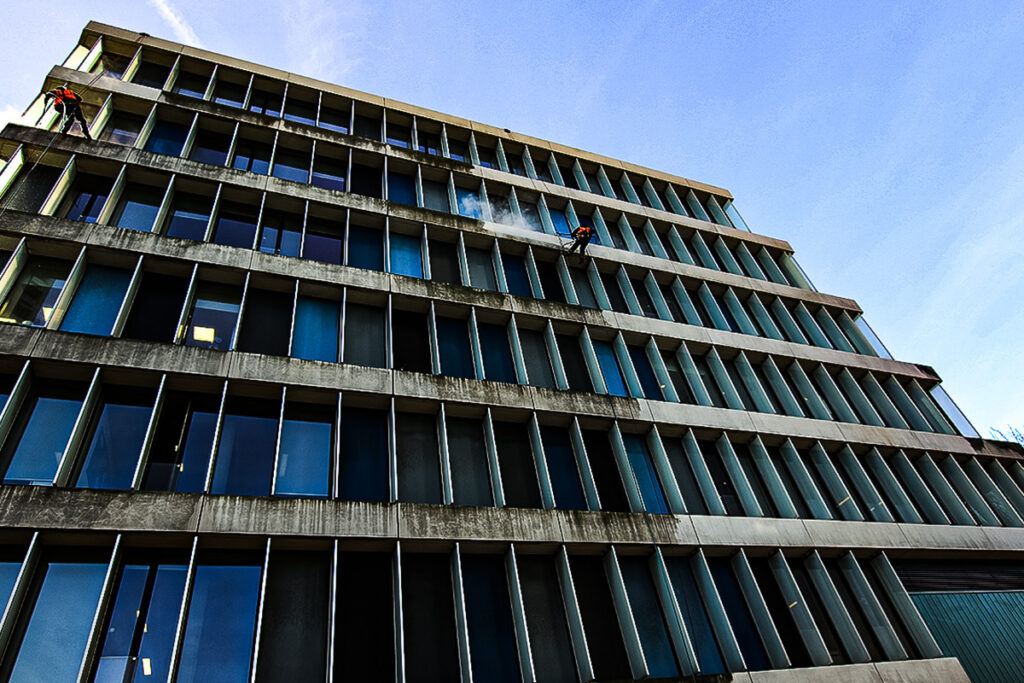
Why Building Façade Maintenance Matters
Commercial façades are constantly exposed to weathering, pollution, moisture and structural movement.
Over time, this can lead to:
- Atmospheric staining
- Biological growth
- Failed coatings
- Cracked masonry
- Failed gaskets and sealants
- Water ingress
- Corrosion around façade systems
- Deterioration of glazing interfaces
Because façade defects are rarely isolated, cleaning is often only one part of the wider building maintenance requirement.
For example, water staining around glazing systems may indicate failed movement joints or deteriorated curtain walling components. Similarly, staining on stone façades can point to trapped moisture, failed drainage or long-term maintenance neglect.
This is why façade cleaning is frequently integrated with façade leak detection, technical inspections and planned maintenance strategies rather than being treated as a standalone reactive service.
You can learn more about Building Transformation’s wider approach to façade maintenance through our façade and curtain walling maintenance services.
Common Commercial Façade Problems
Most commercial buildings experience gradual façade deterioration over time, particularly in dense urban environments or exposed locations.
Pollution and Atmospheric Staining
Traffic emissions, airborne pollutants and environmental exposure gradually stain external surfaces, particularly on stone and masonry façades.
This commonly affects:
- Hotels
- Heritage properties
- City-centre commercial buildings
- Industrial facilities, such as factories and warehouses
- Bridges and structures
- Healthcare or education estates
Over time, pollution deposits can accelerate surface deterioration and contribute to moisture retention within the façade system.
You can read more about how environmental exposure affects masonry façades in our guide to how masonry facades become dirty.
Biological Growth
Algae, moss and fungal growth frequently develop on shaded or moisture-retaining elevations. Beyond appearance, biological contamination can trap moisture against the building envelope and contribute to long-term deterioration of masonry, coatings and sealants.
Failed Sealants and Water Ingress
Many façade defects begin around glazing systems, movement joints and façade interfaces.
Typical symptoms of water ingress in commercial buildings include:
- Internal damp
- Leaks around windows
- Water staining
- Failed glazing seals
- Condensation issues
- Corrosion around curtain walling systems
In many cases, cleaning alone does not resolve the root cause. Investigation and technical diagnosis are required to identify how water is entering the building envelope.Where recurring leaks or moisture issues are present, façade cleaning is often combined with façade leak detection and technical survey work.
Coating Failure and Surface Deterioration
Heritage, Commercial, and industrial building facades may also experience:
- Peeling coatings
- Cracked render
- Surface erosion
- Stone delamination
- Failed paint systems
These issues may also require corrosion control, or specialist industrial coatings and painting and localised repair works alongside cleaning.
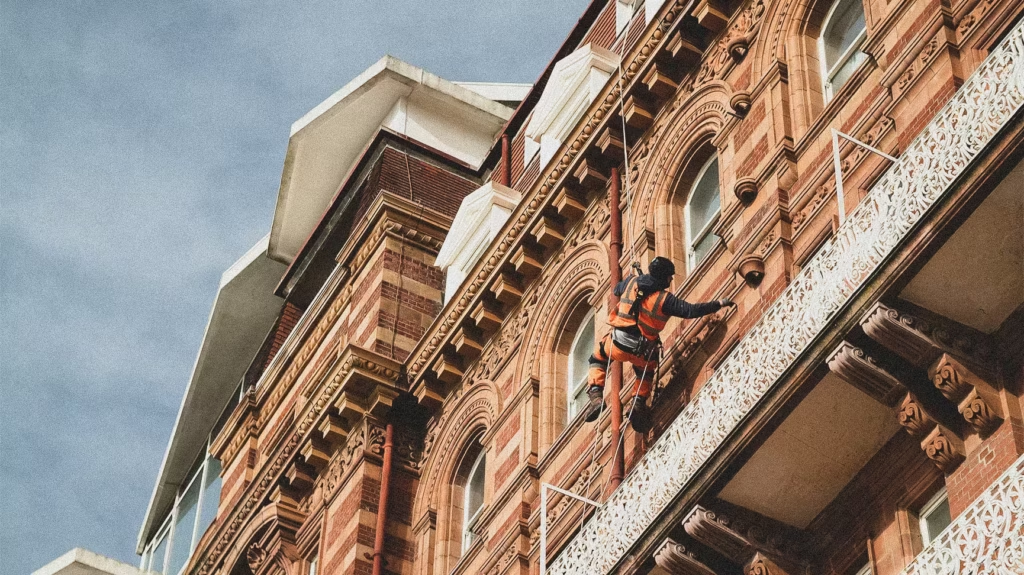
How Façade Cleaning Supports Inspections and Surveys
One of the biggest challenges in façade maintenance is access, which is why abseiling and rope access play such an important role in modern building maintenance and façade inspection strategies.
Many defects develop gradually in areas that cannot be safely inspected from ground level. As a result, problems often remain hidden until water ingress, cracking or visible deterioration becomes severe.
This is why façade cleaning is frequently carried out alongside:
- High-level inspections
- Façade condition surveys
- Building pathology investigations
- Defect mapping
- Maintenance planning
Because rope access technicians work directly on the building, they can identify early-stage defects that may otherwise go unnoticed during visual inspections alone.
This inspection-led approach allows property teams to move from reactive maintenance towards planned preventative maintenance (PPM) strategies based on condition data and technical reporting.
Learn more about inspection-led façade strategies in our guide to quality façade surveys.
When Is Abseiling Used for Façade Cleaning?
Rope access, or abseiling, is increasingly used for industrial or commercial façade cleaning because it allows safe access to difficult or restricted areas without the disruption associated with scaffolding.
For occupied industrial or commercial buildings, abseiling can often provide a safer and more efficient solution where:
- Access is restricted
- Buildings remain operational
- Work is localised
- Public disruption must be minimised
- Traditional access systems are impractical
- High-rise façades require inspection or cleaning
Rope access façade cleaning is commonly used across:
- Hotels
- Commercial offices
- Heritage buildings
- Curtain walling systems
- High-rise developments
- Complex roof and façade geometries
- Industrial, education, or healthcare estates
Because rope access requires less setup than scaffolding, inspections, cleaning and localised maintenance can often be combined within a single programme.
At Building Transformation, all rope access services are carried out by IRATA-trained technicians as part of a wider building envelope maintenance strategy.
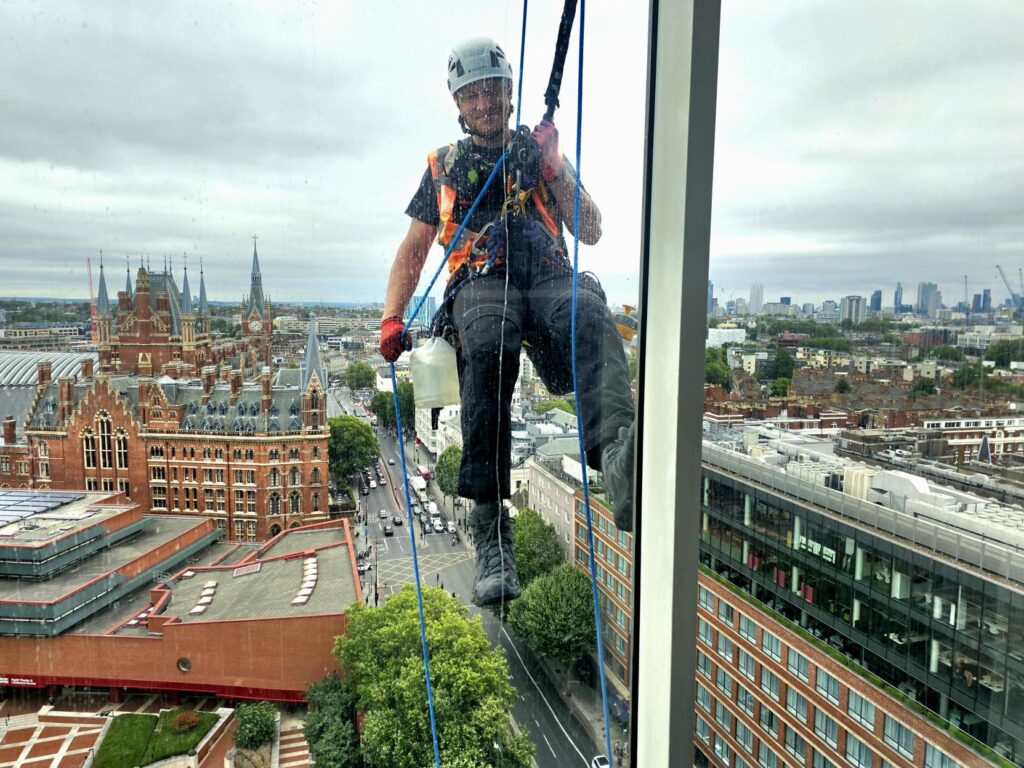
Rope Access vs Scaffolding for Façade Maintenance
Rope access is one of several access methods used within façade maintenance.
The correct solution depends on:
- Building type
- Scope of work
- Duration of works
- Access constraints
- Occupancy requirements
- Safety considerations
In general:
- Rope access is suited to targeted inspections, cleaning and localised repairs
- Scaffolding is more appropriate for long-duration or large-scale refurbishment works
- MEWPs may be suitable for lower-level or easily accessible elevations
In practice, access methods are often assessed together to determine the safest and most commercially practical solution for the building.
For occupied buildings in dense urban environments, or large estates with multiple buildings, rope access can significantly reduce disruption around entrances, public areas and operational spaces, as well as offer cost savings vs scaffolding large areas for localised cleaning and repairs
Commercial Façade Cleaning Methods
Different façade materials require different cleaning approaches. Using the wrong cleaning method can permanently damage stone, coatings or glazing systems.
This is why façade cleaning should always begin with an assessment of the building materials, the type of contamination, and the overall condition of the façade.
Thermatech Steam Cleaning
Superheated steam cleaning is commonly used on sensitive masonry and heritage façades where low-pressure cleaning is required.
This method is often suitable for:
- Stone façade restoration
- Heritage buildings
- Biological growth removal
- Atmospheric staining
Chemical Façade Cleaning
Chemical cleaning systems may be used where deeper staining or contamination requires specialist treatment.
All cleaning products must be carefully assessed to ensure compatibility with the façade substrate and surrounding materials.
Abrasive Cleaning
Controlled abrasive cleaning may be appropriate for some industrial or heavily contaminated surfaces.
However, aggressive abrasive methods can damage softer materials and should only be specified following a technical assessment.
Façade Cleaning, Restoration and Refurbishment
Commercial façade cleaning is often the first stage of a wider maintenance or refurbishment programme. However, facade cleaning companies should also be qualified to identify defects and issues beyond the dirt.
During cleaning works, skilled technicians may identify:
- Failed sealants
- Cracked masonry
- Deteriorated coatings
- Corrosion
- Failed curtain walling interfaces
- Localised structural defects
Where defects are identified, if using an experienced facade cleaning company such as Building Transformation, cleaning programmes may progress into façade repair or refurbishment works.
This can include:
- Façade and curtain walling repairs
- Gasket and sealant replacement
- Façade redecoration
- Curtain walling maintenance
- Stone façade restoration
- Localised remediation works
Related Commercial Façade Cleaning Services & Guides
Explore our
- Façade & Curtain Walling Repairs
- Curtain Walling Gaskets, Mullions & Sealant Maintenance
- Façade Condition Surveys: Curtain Walling Maintenance
- Atrium Glazing Repairs
- Facade Leak Detection
- Atrium Glazing Leak Detection
- Facade Cleaning and Restoration
- Façade Redecoration
You can also read more about
- Rope Access Cleaning: Safe and Efficient Façade Maintenance
- Façade Condition Surveys: How to Spot Problems Early
- Choosing the Best Cleaning Solution For Your Stone Building
- Gasket Replacement: Why Abseiling is the Best Solution
- Cost vs Risk: Why Safety and Quality Matter in Façade Surveys
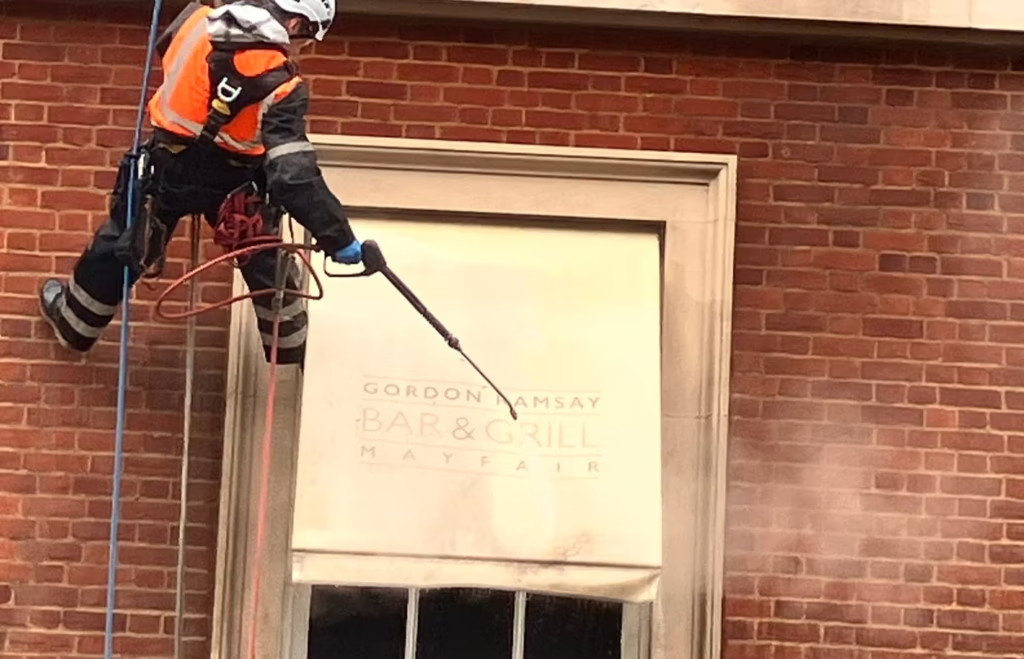
Heritage Façade Cleaning and Sensitive Buildings
Heritage buildings require particularly careful cleaning and maintenance planning.
Sensitive materials such as stone, brick and traditional façades can be permanently damaged by inappropriate cleaning methods or poorly planned access systems.
Our heritage façade cleaning project at the London Marriott Grosvenor Square demonstrates how rope access can support sensitive façade cleaning within a live hotel environment while minimising disruption to operations and surrounding public areas.
How Façade Cleaning Fits Into Planned Preventative Maintenance
Many commercial buildings still operate reactively, only addressing façade problems once visible defects or leaks occur.
However, inspection-led maintenance strategies help property teams identify problems earlier and reduce long-term repair costs.
Commercial façade cleaning often forms part of a wider planned preventative maintenance programme by supporting:
- Regular façade inspections
- Condition monitoring
- Defect identification
- Maintenance prioritisation
- Water ingress prevention
- Asset lifecycle planning
Because rope access allows close-up inspection during cleaning works, technicians can provide valuable real-time insight into defects, risks and maintenance priorities.
This helps clients make more informed maintenance decisions before defects escalate into larger remediation projects.
Choosing the Right Façade Cleaning Company
When selecting façade cleaning companies, commercial clients should look beyond surface cleaning capability alone.
Important considerations when shortlisting specialist access contractors include:
- Commercial building experience
- Rope access capability
- IRATA certification
- Technical survey expertise
- Building envelope knowledge
- Access planning capability
- Safety management systems
- Experience with occupied buildings
- Compliance and accreditation standards
For many commercial or industrial properties, the most effective solution comes from contractors capable of combining cleaning, inspection, rope access and maintenance expertise within a single programme.
Planning Commercial Façade Cleaning or Maintenance Works?
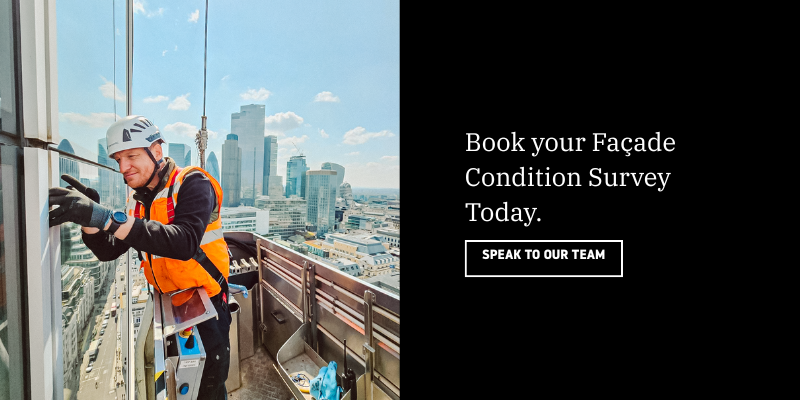
If you are investigating façade staining, water ingress, deterioration or access challenges, Building Transformation can support you with inspection-led façade cleaning and maintenance services across commercial and heritage buildings.
Frequently Asked Questions About Commercial Façade Cleaning Companies
What is façade cleaning?
Façade cleaning involves the cleaning, inspection and maintenance of external building surfaces to remove contamination, improve appearance and support long-term building maintenance.
How often should commercial façades be cleaned?
This depends on the building type, location and exposure to pollution or environmental conditions. Many commercial buildings are cleaned as part of cyclical planned preventative maintenance programmes.
When is rope access used for façade cleaning?
Rope access, or abseiling, is commonly used where buildings are high-rise, occupied or difficult to access using scaffolding or MEWPs.
Is façade cleaning part of planned preventative maintenance?
Yes. Commercial façade cleaning is often integrated into wider maintenance strategies to help identify defects early and reduce long-term repair costs.
Can façade cleaning companies identify building defects?
Yes. Cleaning often reveals hidden issues such as failed sealants, cracks, corrosion and moisture-related defects that may not be visible from ground level.
What is the difference between façade cleaning and façade restoration?
Façade cleaning removes contamination and surface staining, while façade restoration involves repairing or refurbishing deteriorated façade materials and systems.
Is rope access cheaper than scaffolding for façade cleaning?
For targeted or short-duration works, rope access is often more cost-effective because it requires less setup and causes less disruption. However, larger-scale refurbishment projects may still require some scaffolding or alternative access methods. Facade cleaning companies should assess each project and devise the most appropriate specialist access maintenance strategy for the building. This may include a combination of access methods.